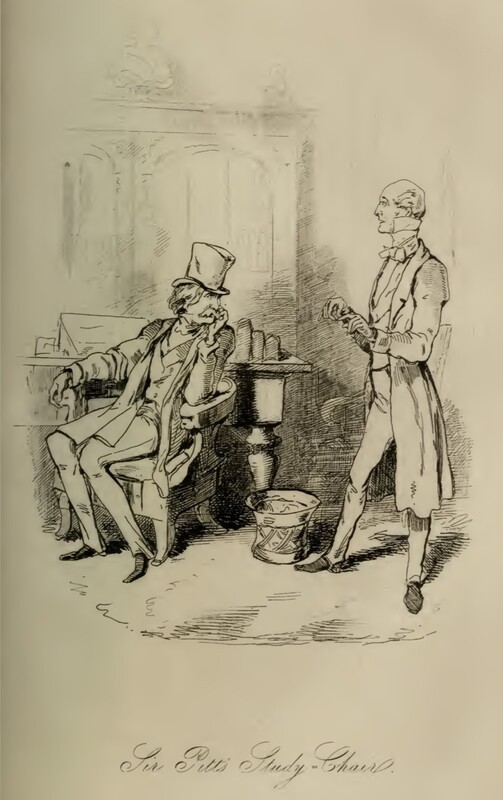
Rawdon Crawley sits in the chair at his brother’s desk with his chin on his hand, looking gloomy. His brother, Sir Pitt Crawley, stands next to him, trimming his nails as they talk. Rawdon wishes for Pitt and Jane to take care of his son once he leaves. Below the illustration is printed in cursive its title, “Sir Pitt’s Study-Chair”.
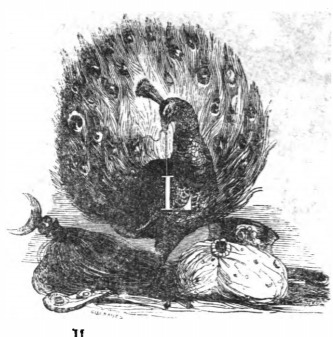
In Luggnagg there is a small population of immortal people. These people are born with a red spot on their forehead, and this spot changes colour over time. This spot is represented by the peacock because of its colours. There is a “L” on the peacock’s chest because this image appears at the beginning of chapter ten and the “L” is the first letter of the chapter. The same image appears in the 1843 Krabbe edition.
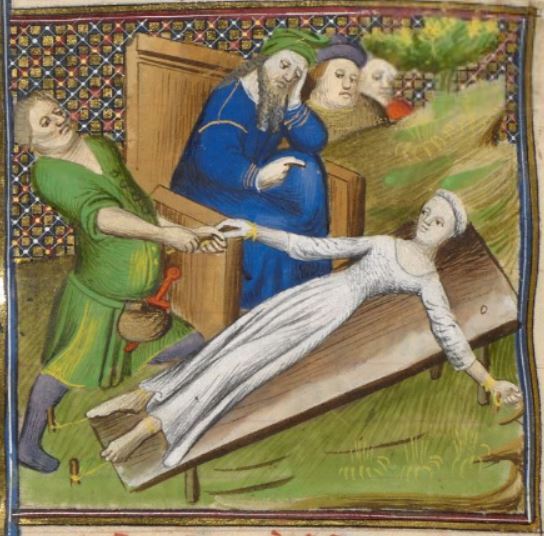
This illumination depicts the freedwoman, Epicharis, being tortured for information regarding a conspiracy to kill Emperor Nero. Epicharis is depicted lying on a large table with her left hand bound and her right hand being tortured. There is a man sitting on a chair who is pointing at her as he interrogates her. Epicharis had overheard the details of a conspiracy to assassinate Emperor Nero, and when she put her faith in the wrong person, they told Emperor Nero that she was involved in the plan. They tortured her many times; however, she did not reveal the names of anyone involved in the conspiracy. She ended up killing herself to avoid revealing the details to the emperor.
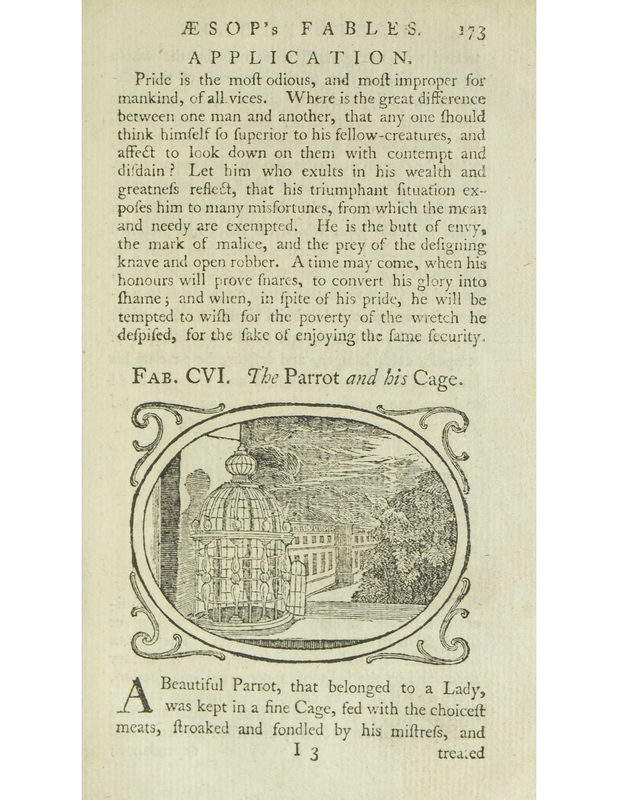
An ornate birdcage sits on a window sill of an upper floor in a building, with the cage door open. A parrot is flying in the background towards a forest. Dark storm clouds fill the sky above buildings in the background.
William Dobbin sits in a wooden chair at his desk, reading the first of his letters, with the others left bundled on his desk. The letter he holds is from Amelia Osborne, congratulating him on his engagement. Though she was told about it by his sister, no such engagement exists.
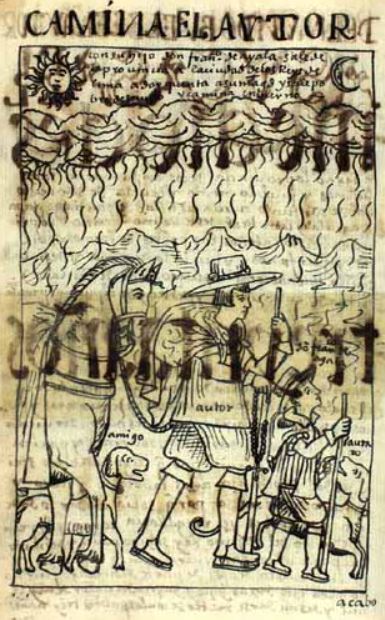
This image depicts the author of the book walking with his son towards the city of Lima to present his book and chronicles to King Philip III’s royal representatives. The author created this book to highlight the injustices done to the indigenous peoples of Peru by the Spanish colonizers, and to highlight the culture of those indigenous peoples. The author is illustrated holding a walking stick in his left hand and a rosary in his right. The word “autor” [author] is written on his tunic. He is depicted wearing a large hat and European styled trousers. He has a sack of provisions resting on his back that has his horse’s reign tied to it. A dog is walking with the company by the horse’s feet and is labelled as “amigo” [friend]. The author’s son is walking in front of the author and is also illustrated holding a walking stick. His name is written above his head as “don francisco ayala.” In front of the child is another dog accompanying them on their journey and is identified as “lautaro.” The background of the image shows that the author is walking in unfavourable weather conditions with many clouds and rain. The caption at the top of the image reads, “sale de la prouincia a la ciudad de los reys de lima a dar quenta a su magestad, y sale pobre, desnudo y camina enbierno” [He leaves the province to the city of the Kings of Lima to give his account to the majesty, poor, naked, and walking in winter].
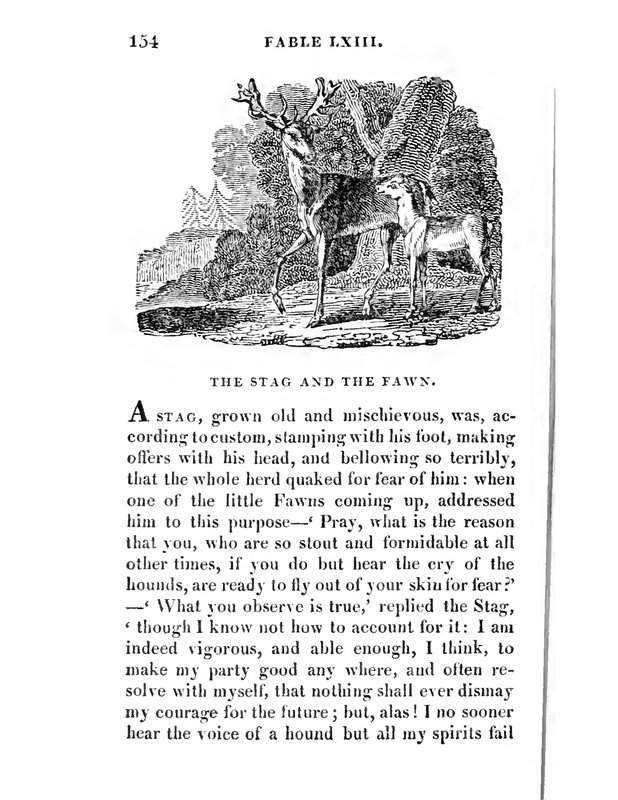
A stag and a fawn stand in a thick forest with several layers of trees. The stag stands tall, with large horns, he lifts his front right hoof. He looks at the fawn. The fawn stands, looking away from the stag.
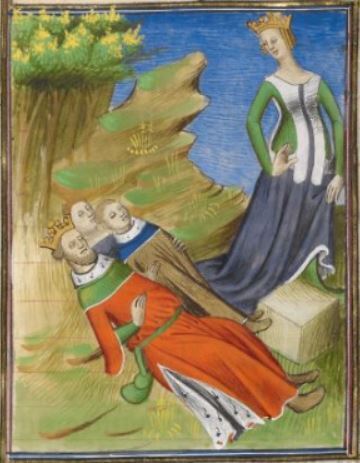
This illustration depicts Niobe, queen of Thebes, on the right side of the image with her children and husband lying dead in front of her. Niobe had many sons and daughters with her husband which made her incredibly proud. Boccaccio explains that when the city of Thebes was making sacrifices to Latona, the mother of Apollo and Diana, Niobe declared that she was more worthy of the sacrifices than Latona because she had more children than her. Every one of Niobe’s children died of the plague as punishment for her hubris against the goddess. Niobe’s husband, King Amphion, killed himself after all their children died, which is why he is depicted laying among the dead children.
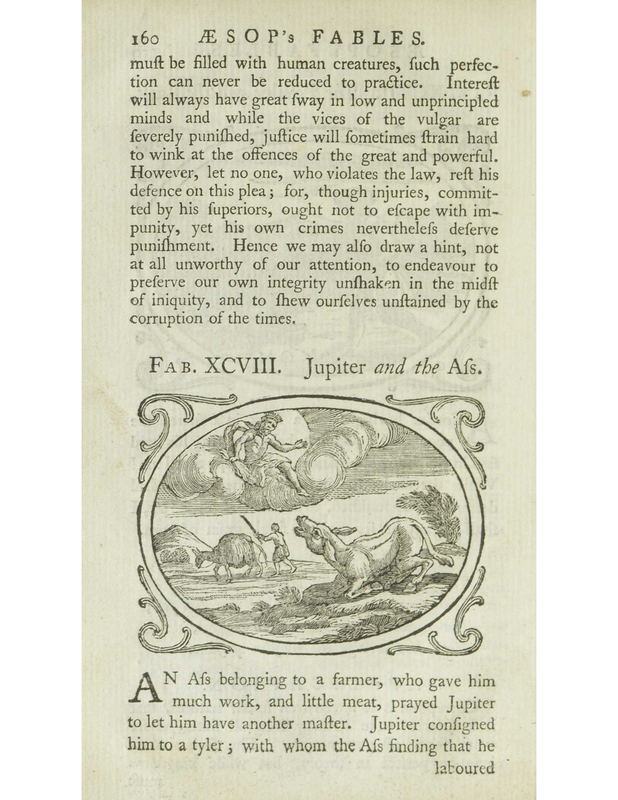
A donkey is laying on the ground looking up at the god Jupiter who sits upon a cloud and appears to be talking to the donkey. In the background, another donkey is being forced to work hard for its master, carrying a heavy load.
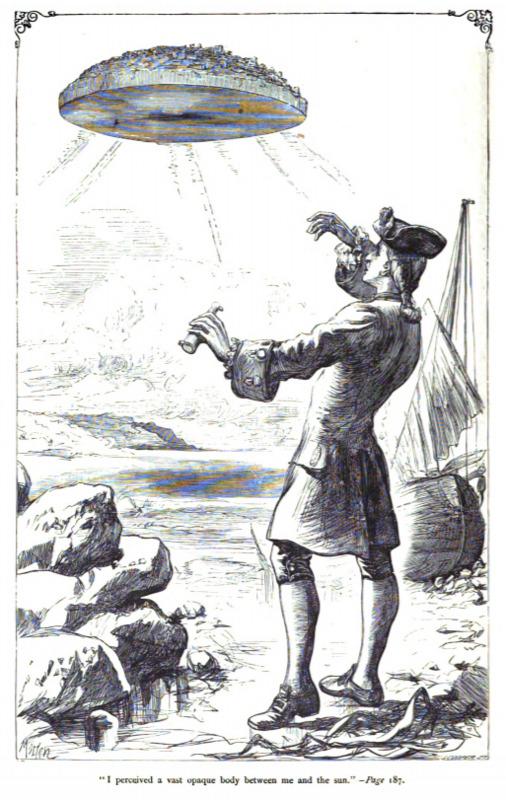
Here Gulliver first sees the floating island of Laputa. Gulliver landed on Balnibarbi – the land underneath Laputa – and looked up to see the island. His attention was drawn to the island when it moved in the way of the sun. It was built on an adamantine base and the movement could be controlled by the King of Laputa.
Rebecca Crawley sits on a sofa next to Milor Noodle in her private room. She is flirting with him in order to get money, as she wins regularly when they play écarté.
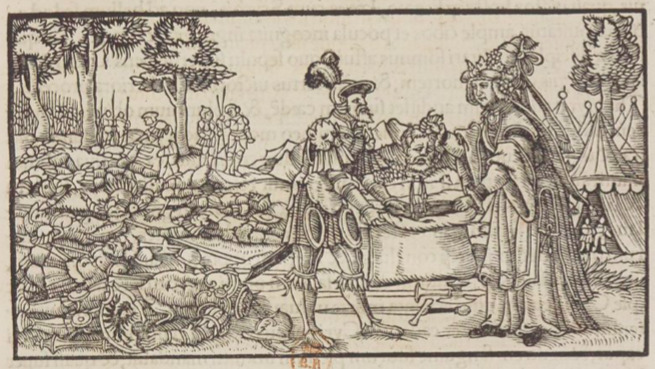
Thamyris, on the right, was the famous queen of Scythia. Cyrus, ruler of Asia Minor, was conquered by Thamyris’s armies after killing many of her men, including her son. Cyrus was killed in the defeat, and Thamyris had his head cut off. In the image, Thamyris places Cyrus’ head (center of the image) in a leather bag with the blood of her men, so that he would forever be surrounded in the blood he desired. Around her are the bodies of Cyrus’ defeated army, and one of her men (left of Thamyris) helping her place the head in the bag. In the background are the survivors of her army which defeated Cyrus.
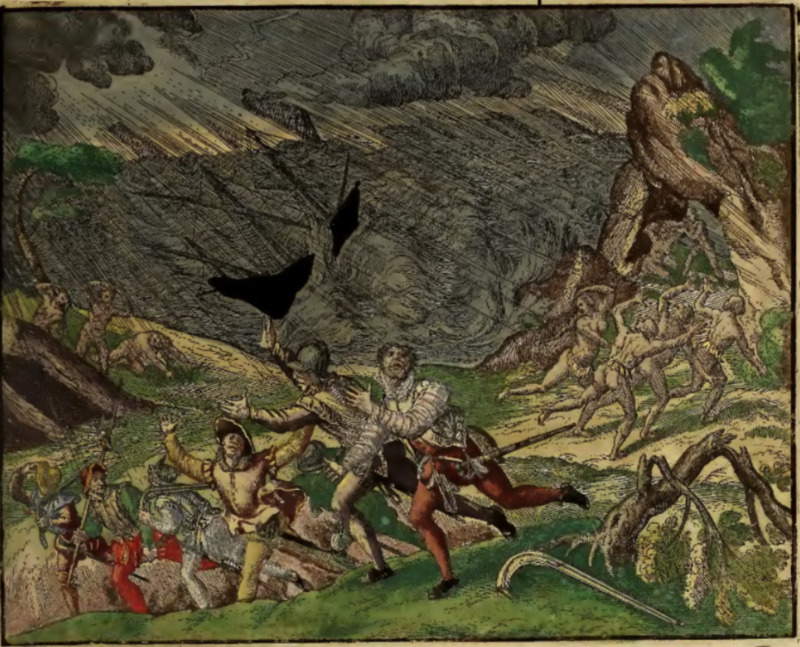
A violent storm hits the island of Hispaniola, capsizing a European ship and knocking down trees. A group of Spaniards flee the hurricane to the left and a group of Indigenous people run to the right amid the driving rain. Lightning forks through the sky and large waves lash the shore. This image is identical to one found on page 169 of Frankfurt, 1594, but colored.
Here we see European sailors who found Gulliver in New Holland. The sailors saw Gulliver’s boat in the creek where it was anchored, and went and investigated it, finding Gulliver hiding. Gulliver explained his situation to the sailors who spoke Portuguese. The sailors were startled by Gulliver’s clothes and story, however, they took him in, and brought him back to Europe. The same image appears in the 1839 Krabbe edition.
A naked woman goddess is looking down on peacock in the outdoors, as she points at the peacock, she is holding a stick in her other hand. Behind the peacock there’s a tree with no leaves and another tree with a wooden plank hanging from one of the branches.
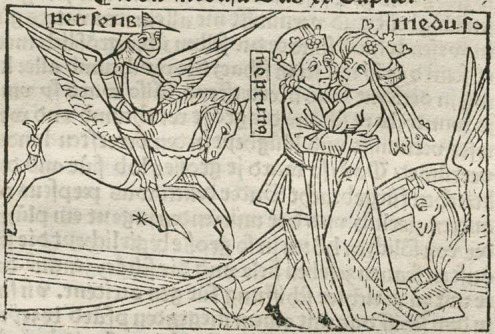
Medusa is illustrated on the right side of the engraving embracing the god Neptune. The creator engraved Medusa and Neptune’s names beside their bodies to identify them. Medusa is depicted in her human form in this engraving before Minerva transformed her into a monster. Boccaccio explains that Minerva transforms Medusa into a monster because she was angry that she had sexual relations with Neptune inside one of her temples. Boccaccio also explains that Medusa ends up giving birth to a Pegasus, which is engraved behind Medusa on the right side of the engraving. The hero Perseus is depicted riding his Pegasus on the left side of the engraving as he is on his way to conquer Medusa’s kingdom. Perseus’ name is engraved to the right of his helmet.
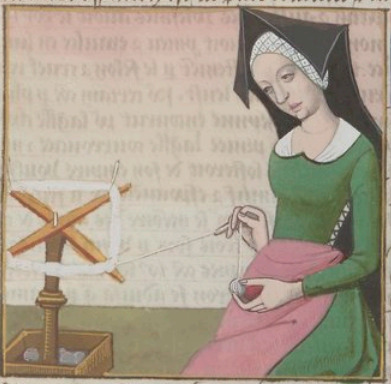
This illumination depicts the freedwoman Epicharis sitting down will spinning wool. Epicharis was a famous freedwoman who bravely endured torture for information regarding a conspiracy to overthrow Emperor Nero. Epicharis endured torture without giving the names of any of the other conspirators. Epicharis hung herself after being tortured twice, as she was scared that she would reveal the names of the conspirators if she were to be tortured again. Boccaccio explains that she is praiseworthy for her bravery and manly resilience.
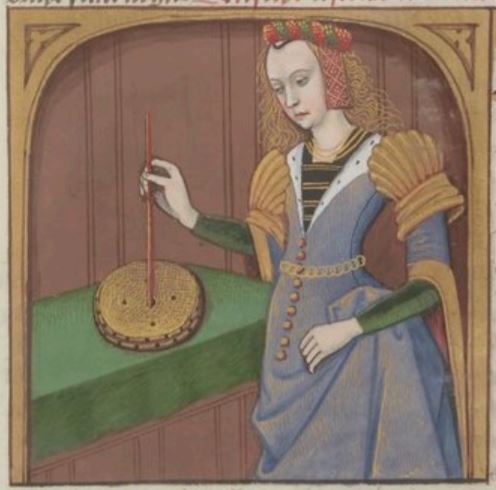
This illumination depicts a portrait of a seer named Manto, who is the daughter of the famous seer Tiresias. Manto is renowned for being able to tell the future by reading the flames and movement of a fire. She was also famous for being able to read the entrails of animals in order to see the future. This image depicts Manto practicing her magic.
Two Tupinambá men are shown. One of the men stands in front of the other. He wears a feathered adornment at his back, attached to his body with a strap over one shoulder, ruffled adornments around both calves, and is otherwise nude. He bends down with one hand outstretched towards a monkey that sits on the ground beside him. The man standing behind him wears a feathered headdress and an adornment on his chin and is otherwise nude. He holds a rattle or an ornament in one hand, and stares at a parrot on a perch to his left.
Here we see the floating island of Laputa. The island sits on an adamantine base with the city built on top. It floats over Balnibarbi and moves around the mainland.
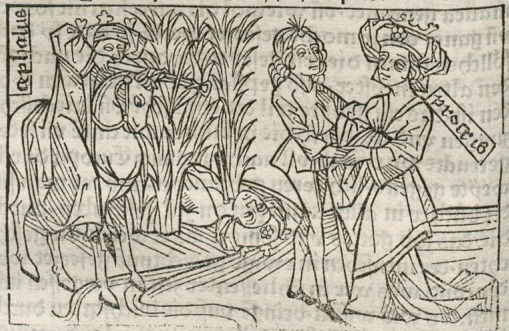
When Cephalus was told that his wife (Procris) would abandon him in exchange for money and treasures, Cephalus began testing his wife. Cephalus would disguise himself and offer her gold and treasures in exchange for her love. This scene is depicted on the right side of the engraving. Procris rejected the disguised Cephalus multiple times, however, she eventually accepted his treasures. In this scene she is holding his hand and looking at him lovingly. Procris ended up regretting what she had done to her husband. To punish herself, Procris went to live in the woods. Cephalus had been hunting one day and had mistaken his wife for an animal and shot her. Procris is visible behind the grass in the background of the engraving while Cephalus is depicted with a cross bow in his hands after shooting her. Cephalus’ name is engraved beside his arm to identify him.
Three men are in some sort of pool swimming. On the other side of the building by the entrance are two men. One man is mounted onto a horse with a sword by his side. The other man is standing by them. There is a bird sitting on the horse’s head.

![[Dobbin’s Letter from Amelia]](https://collections.cemvc.ca/files/large/557ec02475ef7f2f485fc10b29f2414d316c55b0.jpg)
![[Milor Noodle and Rebecca Crawley]](https://collections.cemvc.ca/files/large/28314a1b6ac2e88ede8886df594016cef3254aa9.jpg)
![[European seamen speak with Gulliver on New Holland]](https://collections.cemvc.ca/files/large/d589c089e8923a882eecf7c0e402ea79e55a3f73.jpg)
![[The Goddess and Bird]](https://collections.cemvc.ca/files/large/88f1a579591f509bae36547d1e00063abee7b89a.jpg)

![[Two Tupinambá men with a parrot and a monkey]](https://collections.cemvc.ca/files/large/54c01572bd4b1fe9d8f2f3f66a6ed9de42653dac.jpg)
![[The island of Laputa]](https://collections.cemvc.ca/files/large/160b4d64a0ea09ddcaa62117e796c3930b5c1d9c.jpg)
![[A pool and a horse]](https://collections.cemvc.ca/files/large/70249f64f819372993fcf1e7dfd68fd7ddd8d45c.jpg)