Three Indigenous Brazilian men are in the process of chopping down a tree. One man swings a hatchet at the trunk of the tree, while the other two gather logs or branches. One of the men wears a feathered headdress.
After spending the night with Areusa, Pármeno (rightmost figure) wakes to find that it is already noon. Areusa asks him to stay and talk, but he explains that his master Calisto will already be upset with his lateness. He proposes that they have dinner with Celestina, Elicia, and Sempronio that night, and she happily agrees. When he returns to Calisto’s house, he is met by Sempronio (leftmost figure), who chides him for his lateness. Pármeno explains his new love for Areusa, and Sempronio immediately infers that Pármeno is now working to scam Calisto with him and Celestina. They decide to check on Calisto (central figure) in his bedroom, and they find him in a state of despondency, talking to himself in verse. When he regains a semblance of sanity, he tells them that he is going to Saint Mary Magdalene’s Church to pray for a remedy to his situation.
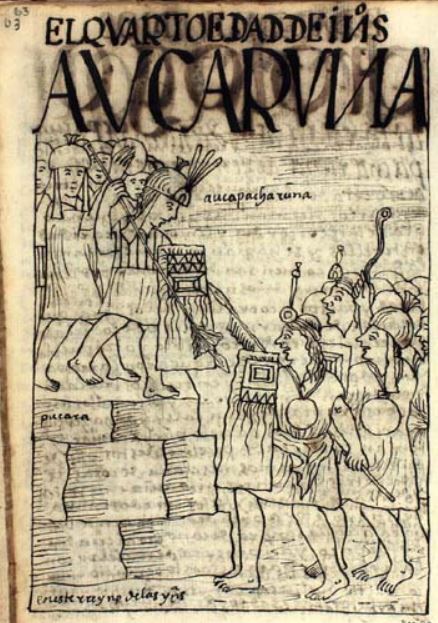
This illustration depicts the Auca Runa people of Peru, who the author describes as a warmongering people, although still devout to God. He explains that these people strategically settled themselves in high mountainous areas in order to protect themselves in war, which is why the people on the left side of the image are pictured on a high structure. The word “aucapacharuna” is written in the centre of the image which the author explains means enemy people or war people. The word “pucara” is written on one of the stones that the Auca Runa are standing on, which translates to “fortress.” At the bottom left corner of the image, the words “en este reyno de las indias” are written, which translates to “in this kingdom of the Indians.”
Here we see Gulliver showing off Lilliputian animals after returning to England. Gulliver sits on the inside of a pen surrounded by eight cows and seven sheep. Gulliver brought these animals back with him after leaving Blefuscu. A crowd of spectators look over a wall at the miniature animals. This image appears before the text of the story, foreshadowing Gulliver’s return to Europe and what he did while in England.
Here we see Gulliver standing in a wide stance, looking down. Underneath Gulliver is the Emperor of Lilliput, identified by his feathered hat and cane. This image shows the difference in scale between Gulliver and the Lilliputians.
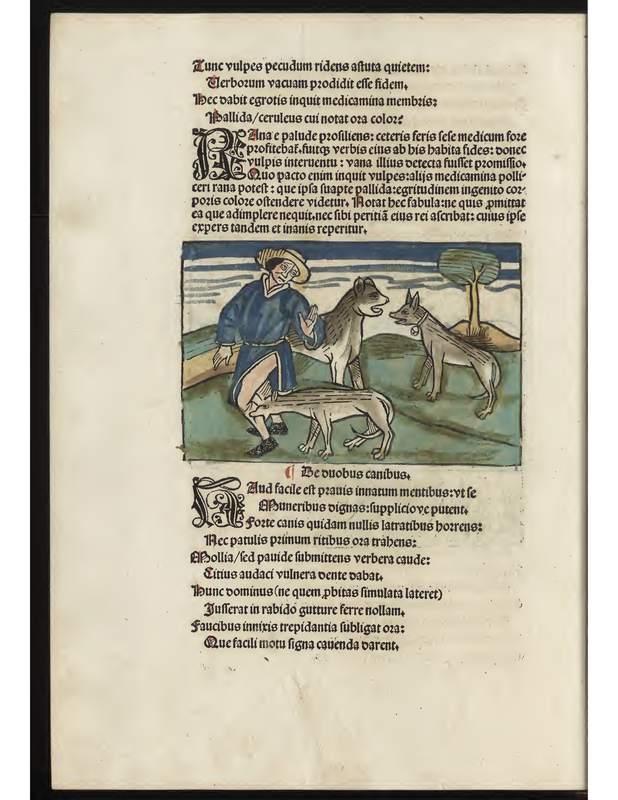
A man is outdoors with three dogs. The man is distressed as one of the dogs bites him on the leg. The other two dogs bark at one another behind the man.
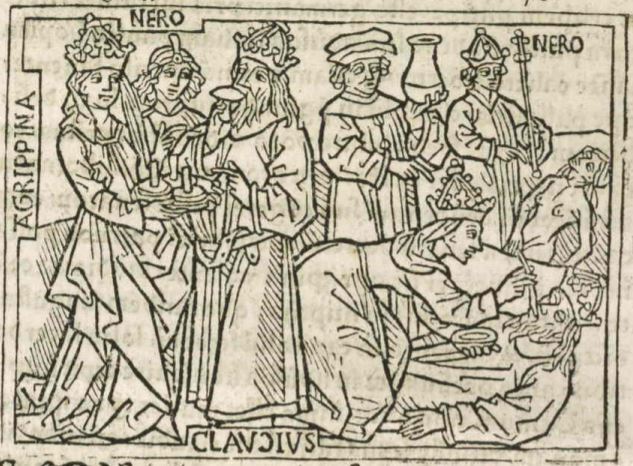
This engraving depicts multiple events. The left side of the engraving depicts Agrippina poisoning her husband Claudius with mushrooms. Agrippina is illustrated wearing a crown and holding a plate of mushrooms as she presents them to Claudius. Agrippina’s name is engraved behind her body, while Claudius’ name is engraved by his feet. Agrippina’s son, Nero, is depicted standing in between Agrippina and Claudius as he watches his step-father being poisoned. Agrippina poisoned Claudius to obtain power for herself and make her son emperor. The right side of the engraving in the foreground depicts Agrippina further poisoning Claudius. Agrippina is depicted on her knees as she feeds Claudius more poison, as the mushrooms did not complete the task. The background of the engraving depicts Nero as emperor, looking at his mother’s dead, naked body. He began to resent her after becoming emperor, and after having her murdered, he observed her dead body and judged it before cremating it. Nero is depicted wearing a crown and holding a scepter, with a man beside him holding a cremation urn.
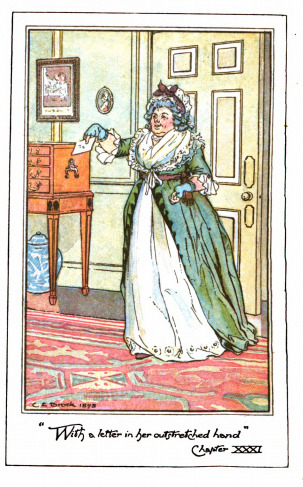
Here we see Mrs. Jennings bringing Marianne a letter from Mrs. Dashwood. Mrs. Jennings invited Elinor and Marianne to accompany her to London in the new year. Marianne wrote to Willoughby after arriving in London, hoping to see him but he ignored her letters. She finally saw him at a party, but he ignored her. She was heartbroken and spent much of the remaining time in London miserable. Elinor wrote to her mother asking her to write to Marianne to make her feel better. Mrs. Jennings announced that Marianne had a letter, saying it would cheer her up. Believing it might be from Willoughby, Marianne burst into tears after finding out that it was from her mother because she felt that Mrs. Jennings had gotten her hopes up. In the letter, Mrs. Dashwood, believing Marianne and Willoughby to be engaged, asked her to be more open about her engagement, not having heard the news that he was engaged to another woman. This letter upset Marianne even more. In this image, Mrs. Jennings walks into the parlor holding out the letter. This scene appears in chapter 31 as indicated underneath the image. The characters are shown in the traditional regency style, with Mrs. Jennings wearing the regency style dress with an empire waist. Her hair is worn tied up with a mop cap covering it. The regency period dated to the early nineteenth century (1811-1820) when George, Prince of Wales, later George IV (r. 1820-1830), reigned as regent for his mentally ill father, King George III (r. 1760-1820). The regency period is associated with the rise of neoclassicism in art and fashion.
Here we see yahoos digging for gemstones. Gulliver’s master explains the relationships among the yahoos in the Country of the Houyhnhnms. Gulliver’s master says that the yahoos enjoy digging for various stones, which they would then fight over. The same image appears in the 1843 Krabbe edition.
After his brief encounter with Melibea in her garden, Calisto (figure to the right) laments the absence of his love. Calisto’s servant Sempronio (on the left) proposes that he employ the help of Celestina, an old procuress and brothel owner. Calisto agrees, and he tells Sempronio to visit Celestina and request her aid. When Sempronio departs, Calisto’s other servant Pármeno warns Calisto against the old woman’s deceptive and treacherous ways.
Queen Clytemnestra of Mycenae is depicted on the far-left side of the engraving wearing a crown. In front of Clytemnestra is the person she has been having an affair with: Aegisthus. Aegisthus and Clytemnestra conjured a plan to kill Clytemnestra’s husband, king Agamemnon, in order to gain control of Mycenae. Clytemnestra gave Agamemnon a piece of clothing that had no neck hole. As he struggled with the garment, the adulterer Aegisthus pierced Agamemnon with a sword (this is depicted on the left side of the image). Orestes, the son of Agamemnon and Clytemnestra, sought to avenge his father’s death. He is depicted on the right side of the engraving killing both his mother and Aegisthus.
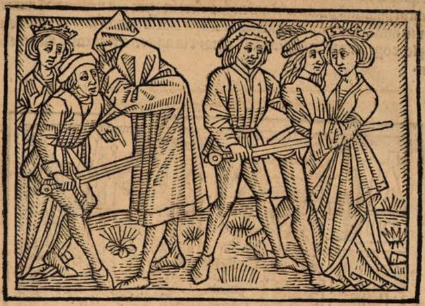
This image takes place in the forest and the background has a hut with a table in it. A person stands beside a creature while having some sort of conversation.
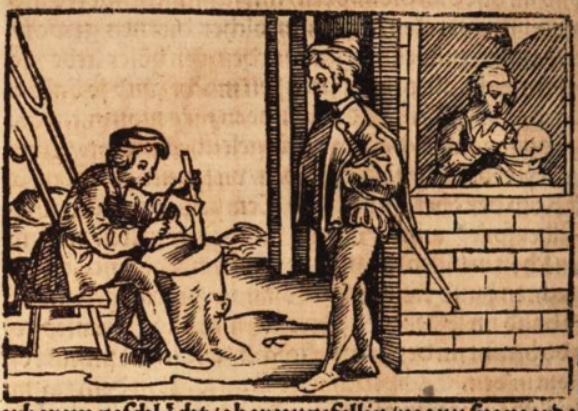
This engraving depicts the story of a young Roman woman who saved her mother from starving to death. Boccaccio explains that this unknown woman’s mother had been sentenced to death, and when she was locked away to die of starvation, her daughter saved her with her own breast milk. The girl and her mother are depicted behind the window of the jail cell as the mother drinks the milk of her daughter’s breast. The men that are standing guard outside the prison cell seem unconcerned and relaxed. One of them is leaning against the wall while the other one is sitting and sharpening a stick with an axe. They are unsuspecting of the young woman because they searched her every time that she visited her mother and she never seemed to carried food with her. Boccaccio believed this woman to be praiseworthy because of the woman’s filial devotion to save her mother.
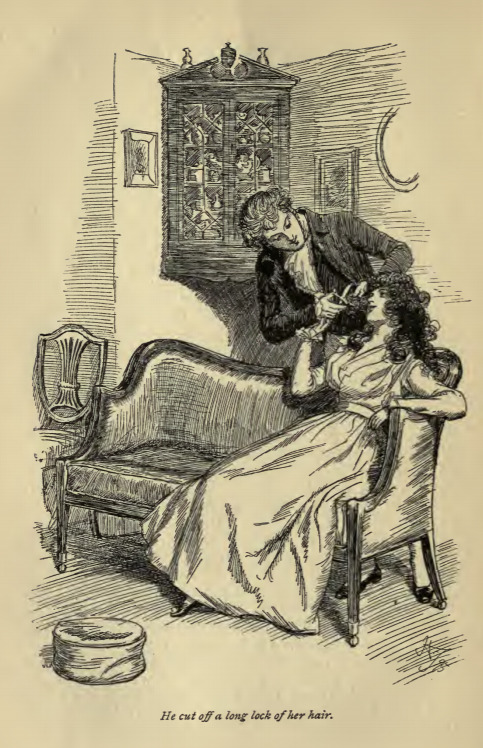
In this image Willoughby cuts a lock of Marianne’s hair. The two were in love and when Willoughby had to leave suddenly, he cut a lock of Marianne’s hair to remember her by. This scene occurs in chapter 12. The characters are shown in the traditional regency style, as Marianne wears the regency style dress with an empire waist. Willoughby wears a waistcoat and tailcoat with breeches and a cravat. The regency period dated to the early nineteenth century (1811-1820) when George, Prince of Wales, later George IV (r. 1820-1830), reigned as regent for his mentally ill father, King George III (r. 1760-1820). The regency period is associated with the rise of neoclassicism in art and fashion.
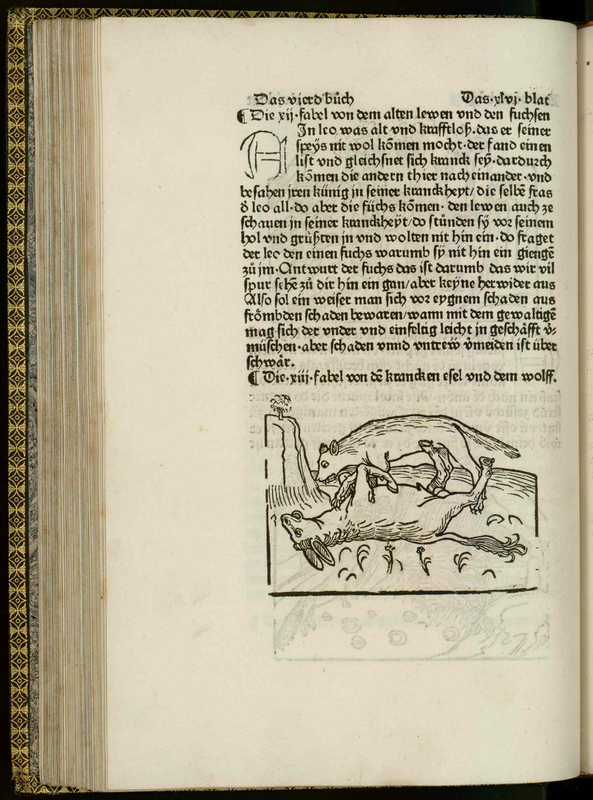
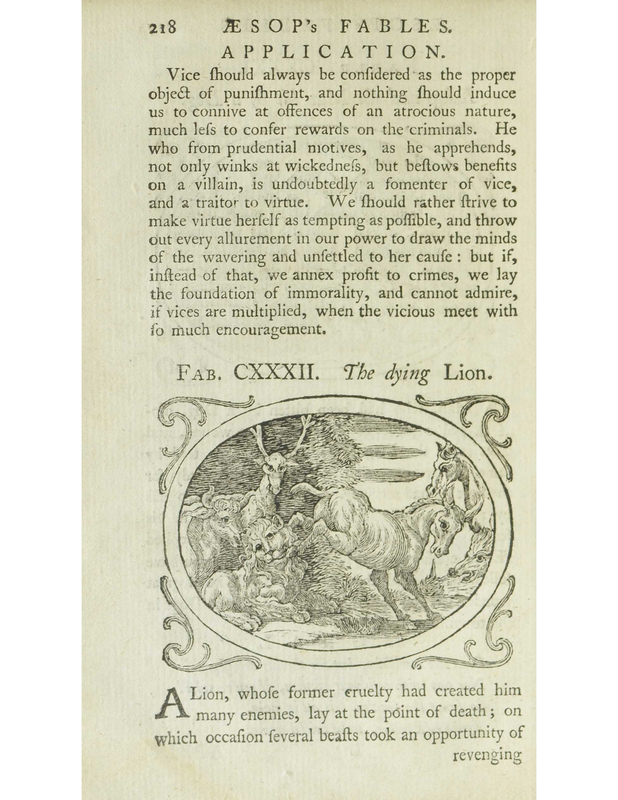
The scene is taken place outside, there are plenty of plants around a group of several animals. There is a Lion, Bull, Ass and four other unidentified animals. Each animal is taking the opportunity to seek revenge against the Lion for the injuries they received from him, and the Ass is seen striking the Lion with his heels in the head.
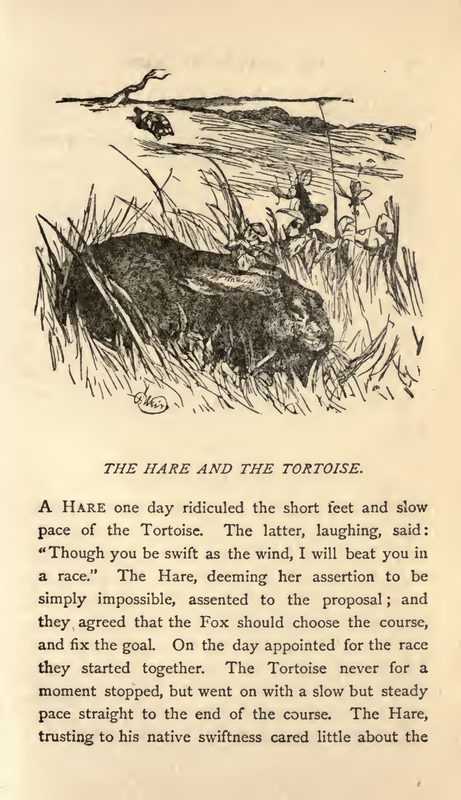
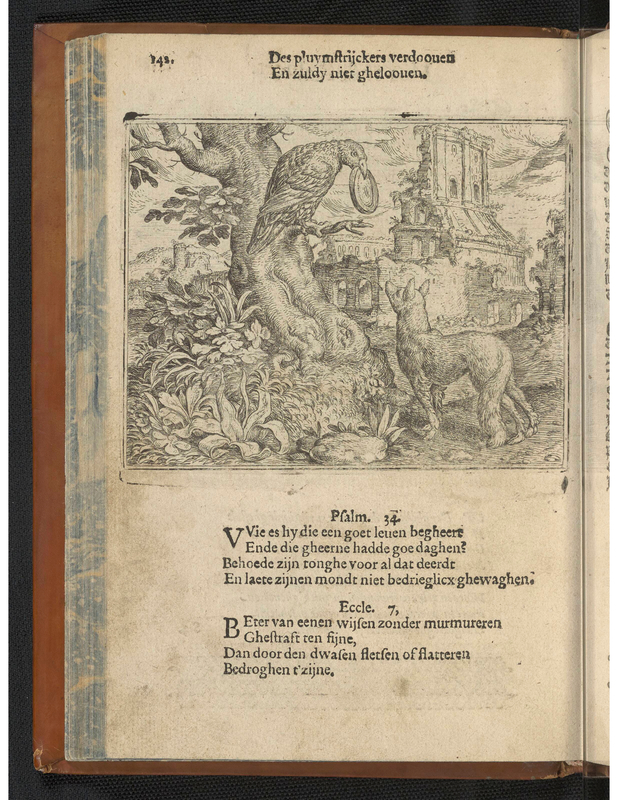
a raven sits in a tree with a piece of bread in its beak at left; at right a fox stands under the tree looking up at the raven; in the background there are classical ruins
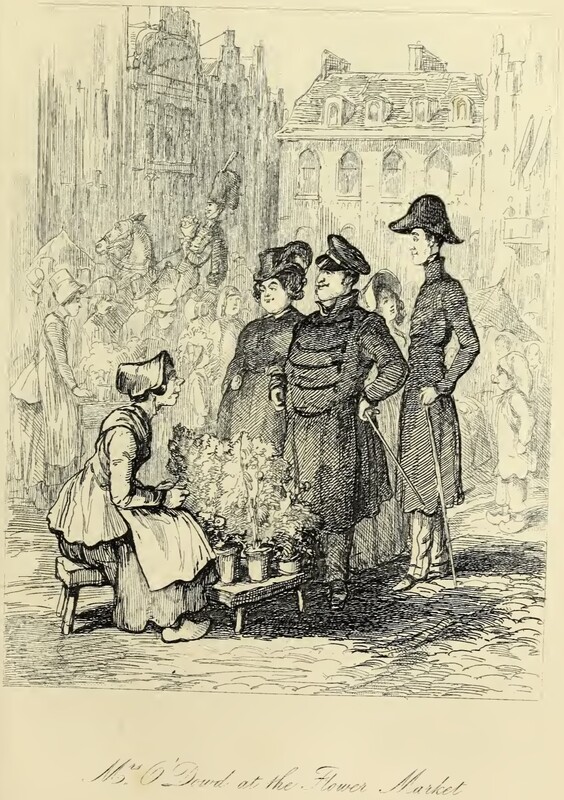
Peggy O’Dowd, in a feathered hat, stands in front of a flower seller at the market in Brussels. She is holding onto the arm of her husband, Major Mick O’Dowd, who has on a cap and is wearing his sword at his hip. Behind the pair are William Dobbin, also with his sword, and Amelia Osborne, who is in a bonnet and looking up at Dobbin. The flower seller is in a bonnet and clogs, seated on a low stool behind the table which holds her rows of potted plants. In the background of the image are the crowds of shoppers, another flower seller standing at her table of plants, a moun Women; Women, White; Men; Men, White; Soldiers; Markets; Sales personnel; Flowers ted officer holding a bouquet, and the tall, ornate buildings that surround the market square. Below the illustration is printed in cursive its title, “Mrs. O’Dowd at the Flower Market”.
In the left panel, we see a female figure wearing a robe and a veil. She is holding some sort of book between her body and her right arm. To the right, another female figure is shown in similar (although fancier) attire. In her right hand she is holding a flower, while in her left she is holding the girdle cord hanging from her waist. At her feet, a dog is standing on its hind legs with its front paws extended toward her. Both figures are placed outside.Because this act includes four female characters who all speak amongst each other, it is impossible to identify exactly whom either figure is meant to represent.The entire image is nearly identical to the one found on page 82 (where each figure is given a name label).The panel to the right is a near carbon-copy of a panel found multiple times throughout the earlier 1529 Lyon edition. However, the lower attention to detail in this panel makes it clear that it is a reproduction and not a duplicate. The artist likely referred to a copy of the 1529 edition when creating this panel.
A man stands outside in front of a cave. Within the cave crawls a roped man. The man outside of the cave pushes the other man into the cave. Behind the cave stands a lone tree.

![[Indigenous Brazilian men chop down a tree]](https://collections.cemvc.ca/files/large/74b2a3529f09e44c308e9302b528943c7621b270.jpg)
![[Act VIII – Sempronio, Calisto, and Pármeno Talking]](https://collections.cemvc.ca/files/large/5513708f6bfa1b03a05f3fbbe0e4276f86c601c6.jpg)
![[Gulliver shows off Lilliputian animals in England]](https://collections.cemvc.ca/files/large/caf394e7c0e608f9cc2416702ffd35d54d029ae5.jpg)
![[Gulliver stands with a Lilliputian underneath him]](https://collections.cemvc.ca/files/large/86b71e6f2f0b489dbc6323596df664cc17cdcb01.jpg)


![[Yahoos digging for gemstones]](https://collections.cemvc.ca/files/large/4018df1380fa8c6f3c0c77de7e14d78be6cbef11.jpg)
![[Act I (Second Illustration) – Calisto Laments the Absence of Melibea to Sempronio]](https://collections.cemvc.ca/files/large/1a12bc28df493c478fc19b1e22f884a7555b68f0.jpg)
![[Person meeting Creature]](https://collections.cemvc.ca/files/large/afd4d84cf95e661d9ee0cf10a6bc372f950dded8.jpg)

![[Act X (Mislabelled as 'Septiesm acte'/Seventh act) – ? and ?]](https://collections.cemvc.ca/files/large/12d4c334e7d432ba536ecb8ab17e6b39aa13b84f.jpg)
