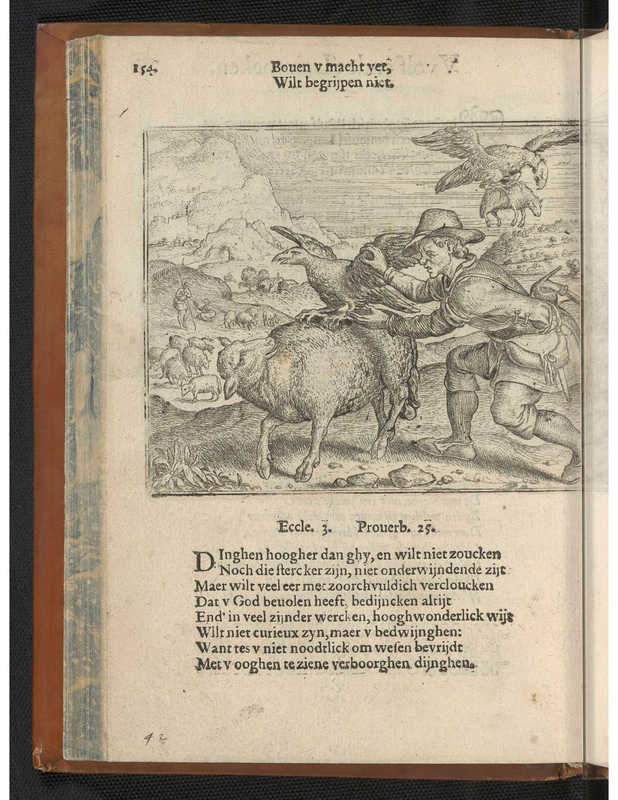
A shepherd at right protects his sheep from an eagle grabbing the sheep's back at left; in the upper right corner an eagle flies away with a sheep in its claws; in the background there is a shepherd with a flock of sheep.
Lord Steyne, the scar on his forehead visible from when Rawdon Crawley threw his diamond back at him, drinks from a wine glass at Prince Polonia’s entertainment. He is standing next to a taller man, who is reaching out to take a glass from the tray a nearby serving man holds.
In this image we see the farmer’s baby trying to put Gulliver in its mouth. The baby holds Gulliver by the waist and tries to put Gulliver’s head into its mouth. Gulliver’s legs and arms flail in concern. A woman holds the baby and watches what is happening before stopping the baby from killing Gulliver. The baby wears a bonnet and a shirt with a vest. The same image appears in the 1843 Krabbe edition.
Here we see three Laputan scholars attended by their Flappers. The Laputans were so deep in thought they could not speak. The Flapper was a servant who carried a blown bladder filled with peas or pebbles and was used to communicate. The Flapper attended the wealthy scholars and when they wanted to converse with one another, they would gently tap the bladder on the mouth of one person then on the ear of another. Because the scholars could get so wrapped up in what they were thinking about, they would stop what they were doing or seemingly stop seeing anything around them. The Flapper would then tap their eyes to help remind the scholars of what they were doing. Thus, the Flappers were there to help the scholars through their daily life. In this image we see three scholars in the front, lost in thought, with their Flappers behind them. On the far left, we can see the bladder used by the Flapper. The Laputans wear clothes and hats with astronomical and musical motifs. The Laputans’ faces were not symmetrical, with their heads tilting to one side, and one eye turning inwards and the other looking straight up. The same image appears in the 1839 Krabbe edition.
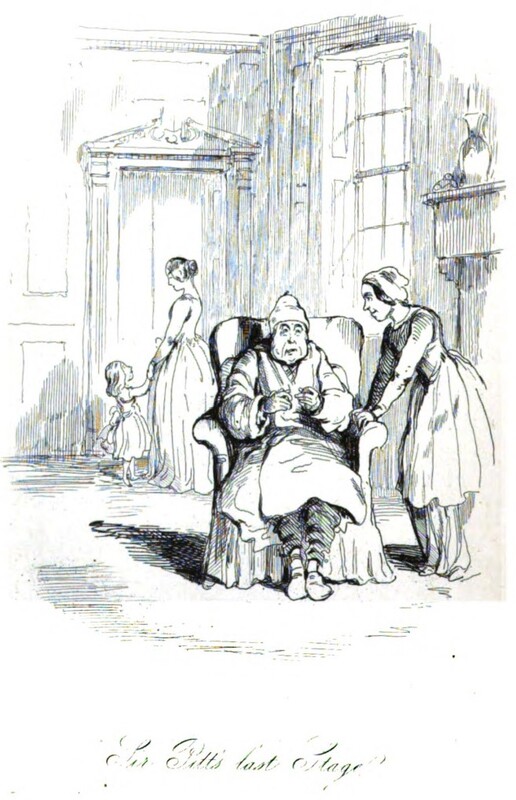
Sir Pitt Crawley, in a nightcap, sits in the chair in front of the fireplace in his apartments. Behind him, Lady Jane Crawley and her daughter, Matilda Crawley, are holding hands as they leave the room. Next to Sir Pitt, Miss Hester, now his nurse, has turned his chair away from the fire with a scowl on her face. Below the illustration is printed in cursive its title, “Sir Pitt’s last Stage.”
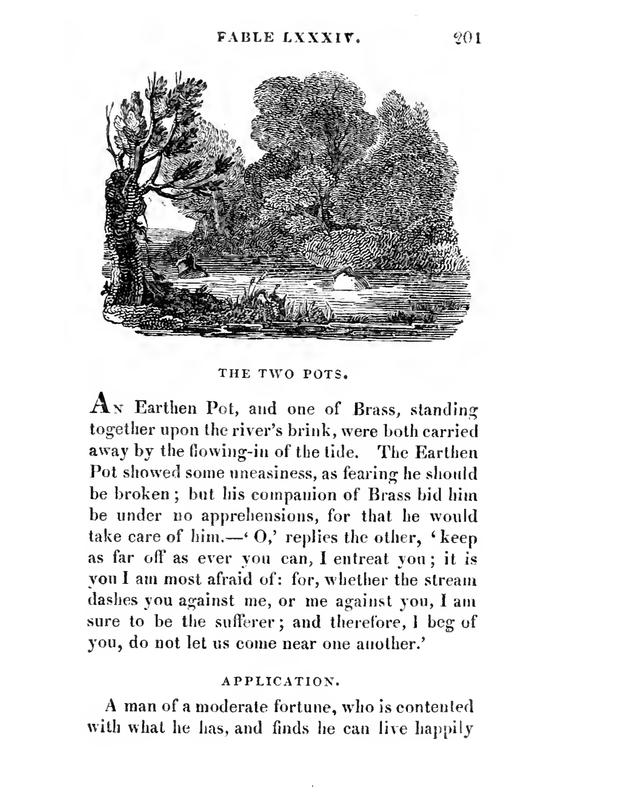
On the left-hand side of the image there is a pot floating down a river. On the right-hand side of the image there is another pot floating down the same river. Surrounding the two pots there are many trees, bushes, plants, and weeds.
On the left we see Calisto, who is dressed in noble attire and has a sword mounted on his belt. The right panel depicts Sosia pointing upward. He also has a sword mounted on his belt.The entire image is nearly identical to the one found on page 43 (where the right panel is labeled ‘Pármeno’). The left panel is identical to those found on pages 8, 162, and 196. The right panel is identical to those found on pages 221 and 235, and is nearly identical to those found on pages 105 and 135 (where it is labeled ‘Pármeno’).
As midnight approaches, Calisto, accompanied by Pármeno and Sempronio, departs for Melibea’s house. Calisto hears two women talking through the door, and he asks if Melibea is there. Lucrecia (likely the central figure) talks to him first, ensuring that he is really Calisto. She then retreats, allowing Calisto and Melibea (likely the two leftmost figures) to speak. Pármeno and Sempronio (likely the two rightmost figures) hear a commotion in the distance and begin to flee, but they return when they realize the noise is coming from the alguacil’s (justice’s) night watch, who are patrolling another street. However, the night watch soon enters on Melibea’s street, causing Calisto and his servants to flee. Calisto returns home to lament the short duration of his meeting with Melibea. Meanwhile, Sempronio and Pármeno pay a visit to Celestina, with the intention of demanding their share of the gold chain that Calisto had given her.[The figures in this illustration are used in multiple other illustrations throughout this edition.]
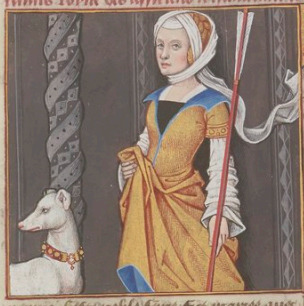
This illuminated image depicts Semiramis, an ancient queen of the Assyrians. She is depicted wearing clothing specific to the time of the creation of the image. She is holding a part of her dress in her right hand while holding a scepter of some sort in her left. There is a dog on the left side of the image. Boccaccio explains that he wrote on Semiramis as she is renowned for having sexual relations with her son, as well as inventing the chastity belt.
The Indigenous town of Secota is pictured. Multiple structures are grouped along a flattened path. There are cultivated fields all around the structures where corn and other crops are seen in varying stages of growth. There are several bonfires, and in the centre of the village several individuals are grouped around a meal. There is a dance circle where a ceremony is taking place, several people sit and others dance. Elsewhere a few individuals hunt or practice with bows and arrows.
Here we see Gulliver's introduction to the Houyhnhnms who took Gulliver in. The Gray horse who found Gulliver brought him to an authority of the Houyhnhnms. He introduced Gulliver to a mare with a colt and foal, sitting on mats woven out of straw. The same image appears in both the 1839 and 1843 Krabbe editions.
In chapter six, Gulliver explains finances and the English fiscal system and Treasury to his Master on the Country of the Houyhnhnms. Here we see a figure made out of bags of money. The figure sits on a globe, standing on the European continent. On the left side we see the scales of justice, unevenly balanced towards the money, representing the unevenness of the justice system. The same image appears in the 1839 Krabbe edition.
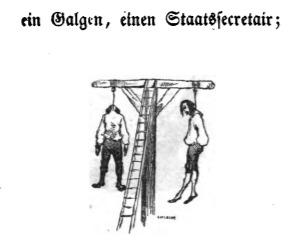
This image depicts a gibbet, which is where the bodies of criminals were hung after their execution. The gibbet was the code for the Secretary of State. This image comes in a description of a conspiracy found by a professor from the Grand Academy on Balnibarbi. This idea is representing code word for terms in the conspiracy that Swift is satirizing. The professor advises that those named in the conspiracy papers be closely monitored at all times, naming specifically while they were using the bathroom, as this is when men were most thoughtful. This conspiracy is thought to be an allusion to the trial of Francis Atterbury, the bishop of Rochester for allegedly plotting with the Jacobites. Atterbury was charged with treason in 1722 and was exiled to France. The same image appears in the 1843 Krabbe edition.
Gulliver explains the various medicines used in England to treat disease. In this image we see a doctor standing at a counter mixing various herbs, minerals, juices, skins, and other ingredients to make medicines. On the counter we see vials with ingredients, and above the counter is an alligator which would be used in some medicines. The same image appears in the 1843 Krabbe edition.
A group of Indigenous men, women, and children cry of happiness, some with their hands over their faces or clasped in front of them in displays of emotion. One man sits in a hammock, while two others stand around him, and three women and a child crouch or kneel on the ground. Two European men stand beside the group, dressed in long robes with caps on their heads. The child sits on the ground near the feet of one of the men and pulls on the bottom of his robes with one hand. Two structures are visible, one directly behind the group and another in the distance. This image is identical to one found on page 929 of Paris, 1575 (l’Huillier).
Two sticks-the left one forked, the right one pointed-hold up a banner with the title “Vanity Fair”. Each letter is on a separate piece of paper, connected by a string tied to the sticks. Beneath the banner is printed the subtitle and author, “A Novel without a Hero by William Makepeace Thackeray”. At the base of the banner, a haggard man with a plumed helmet is lounging against an open chest, holding up a mirror from which he peruses his reflection. By his side are a doll and what appears to be a handmade axe or hammer, with a flat rectangular stone or piece of wood tied to a longer, thinner stick. In the background can be seen trees, a fence, and several buildings.
A woman and a man are talking. The woman, on the left, is wearing a long dress that reaches her ankles. Her long hair is tied up in a ponytail. She has a long nose, and a short face. Behind her, there is a tall brick house with a door opening, inside the house two tall vases are seen. The man, on the right, is shorter than the woman, he is reaching out with his right hand to grab hers. He has shoulder length curly hair. He is not wearing any shoes although they are standing in a field. Behind him are tall fruit trees.
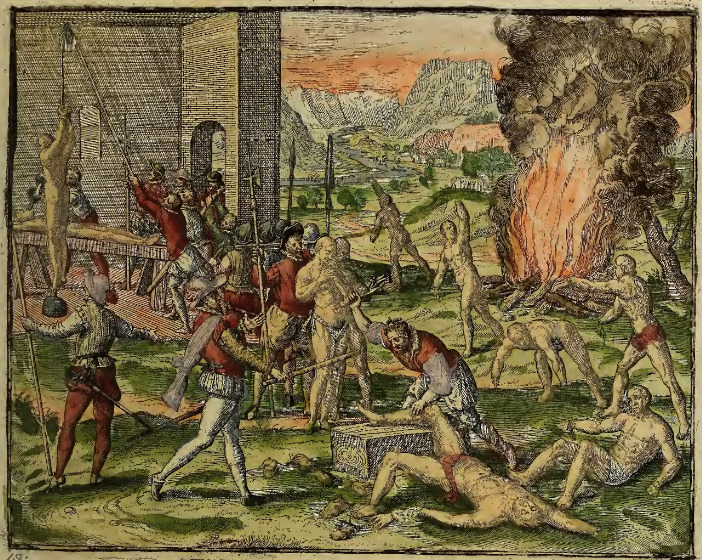
Hernando de Soto was a Spanish man who governed the Spanish territories of Cuba and La Florida (a large area of the modern Southern United States, including the present-day state of Florida) from 1536 to his death in 1542. Here, he and several fellow Spaniards torture and kill Indigenous people in Florida. In the foreground, an Indigenous man lays on the ground with one leg raised on a wooden block while a Spaniard holds a weapon poised over his raised leg. The Indigenous man has already lost both hands, and several other Indigenous people nearby have also had their hands cut off by the Spanish. Several severed limbs lay on the ground. To the left, an Indigenous man has been hung inside a structure while several Spaniards watch. Another Indigenous man has been tied down on his back on a wooden table while a Spanish man pours a liquid into his mouth using a funnel. A large fire burns on the right. This image is identical to one found on page 151 of Frankfurt, 1595, but colored.
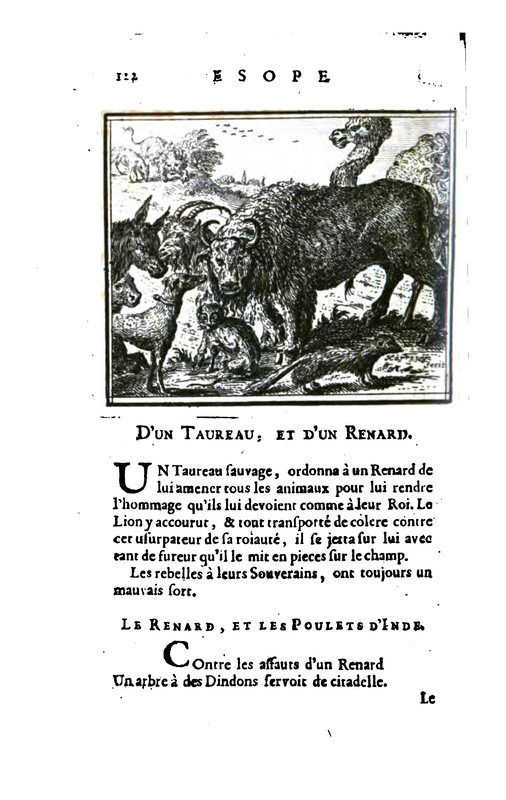
A bull orders a fox to bring him all of the animals that think of him as their king. Upon hearing this a lion becomes angry over his power being threatened, and runs up, throws himself onto the bull with great rage, and tears the bull to peices. Rebels against their rulers, always face a terrible fortune.

![[Lord Steyne at the Refreshments]](https://collections.cemvc.ca/files/large/02bda3626d4d5ff531a522d71b46ab156eef9155.jpg)
![[A giant baby tries to eat Gulliver on Brobdingnag]](https://collections.cemvc.ca/files/large/6c7467503f0263577a9cb2201cc197dc073a4955.jpg)
![[Laputan scholars and their flappers]](https://collections.cemvc.ca/files/large/caff758eaeecf6f791a454835771d60c16b13a29.jpg)

![[Act XIII – Calisto and Sosia]](https://collections.cemvc.ca/files/large/6c8d2d92617162e9982ed83bba907ee2c749bd27.jpg)
![[Act XII (First Illustration) – Calisto, Melibea, Lucrecia, Pármeno, and Sempronio]](https://collections.cemvc.ca/files/large/15359607b2385b71702866b72939873dc358b5d0.jpg)


![[Gulliver meets the Houyhnhnms]](https://collections.cemvc.ca/files/large/24ed4b34774e00feaddf9d92855b46114c358521.jpg)

![[A representation of uses of money in Europe]](https://collections.cemvc.ca/files/large/6543c7f56bc654634e14e1f9e9250c69eb69da90.jpg)
![[a doctor mixes medicine]](https://collections.cemvc.ca/files/large/b8b3480acef61f96445fe12796c5f26c05d4e67d.jpg)
![Femmes & filles pleure[n]t de joye.](https://collections.cemvc.ca/files/large/d2a18b5803822e2a0dddc036cb274fda8693017f.jpg)
![[Vanity Fair Title Page]](https://collections.cemvc.ca/files/large/d06b6f62f23b68d301e8145efd7009b7cf10a705.jpg)
![[The Rich Woman and the Poor Man]](https://collections.cemvc.ca/files/large/c03a98c37ade571c7849b6a546432fa924886ef6.jpg)