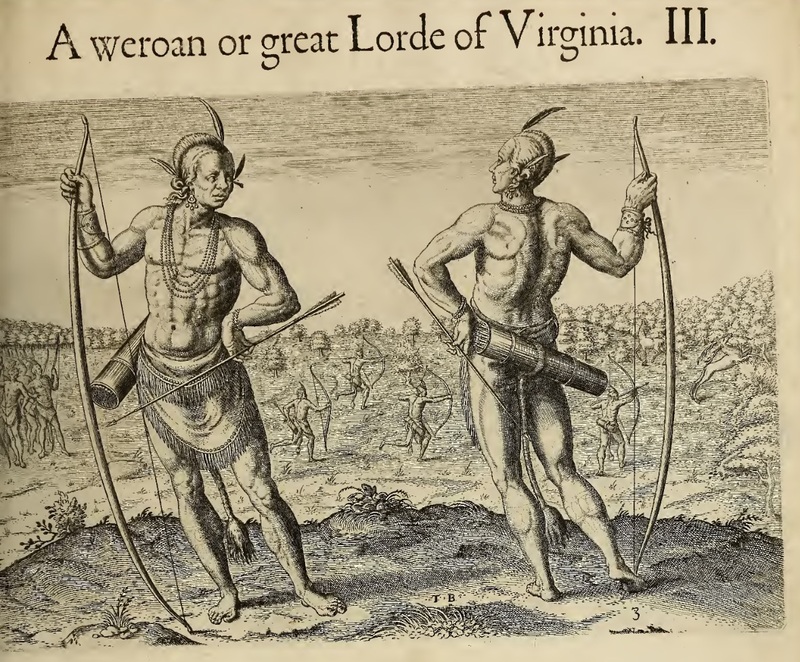
An Indigenous male is pictured standing on a hill, from the front and from behind. He wears beaded necklaces, beads around his left wrist and a cuff/wrist guard on his right, and fabric in the fasion of a fringed skirt tied around his waist. He is barefoot and shirtless, carries a longbow, and wears a quiver of arrows around his waist. In the background behind him there is a group of Indigenous people also holding longbows, and four people hunt deer. A forest is visible in the background.
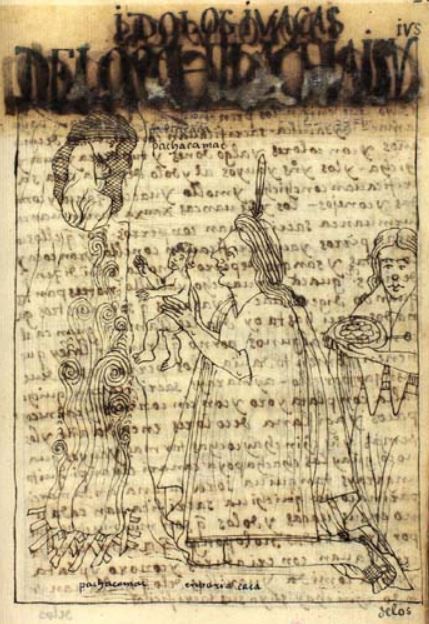
This chapter is dedicated to describing the idols and gods of the Incas. This image depicts the Inca king performing a sacrifice of a young child to the deity Pachacamac. Pachacamac is depicted in the top left corner of the image looking down to the Inca. There is a fire burning below the deity which is being used to sacrifice the child. There is a woman standing behind the Inca holding a plate of food, which was also sacrificed to the deity. The word Pachacamac is written beside the deity to identify it. The words “en Paria Caca” are written at the bottom of the image to identify where this image is taking place, which is in Pariacaca.
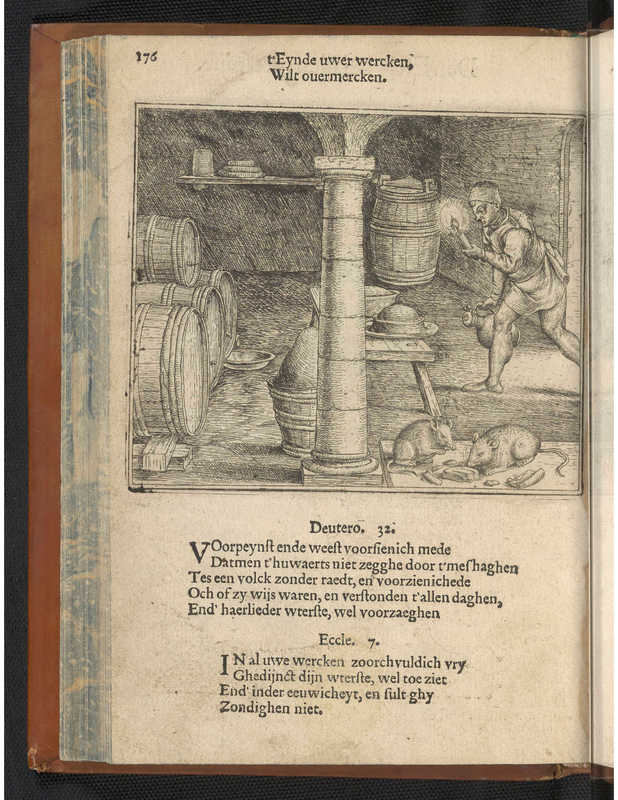
Two rats in the lower right corner in an interior are eating from a piece of food; in the background there are wine barrels and a man walking towards the barrels with a candle and a jug in his hands.
Two girls kneel next to a toy chest, the lid of which is engraved with “FINIS”. It contains assorted items, including a set of dolls in the forms of Dobbin, Amelia, and Georgy, and on the ground beside it one of Jos, Becky, and a devil. Beneath the image is printed the publisher’s information, “London: Bradbury & Evans, Printers, Whitefriars.”
Mercury the celestial messenger, esteemed himself more than the rest of the gods, and treated them all as wretches of this world. The God of war, although his Father, was a deceiver and a brute. Saturn with his scythe was a rambler; Atlas an old book; Momus a fool; Minerva with her arts a precious one, and so on and so forth, he was the perfect god. One day he left the heavens and took on a human form and came to the city of Thebes, where he went for a walk and entered the workshop of a sculptor, where he said to him: "My friend, I would like to buy the statues of the gods."
Gulliver left the floating island of Laputa to go to Balnibarbi. He arrives and goes into the city of Lagado. He says it is about the size of London, however, most of the buildings had fallen into disrepair. The people often wore rags, walking quickly through the streets. There was also a distinct lack of agriculture despite the good quality of the land. In this image we see some of the locals of Balnibarbi walking through the streets. In the background we see houses that are falling apart. For example, on the right hand side we see a house whose walls are not straight, but are bowing out, and rubble underneath the window. The same image appears in the 1839 Krabbe edition.
Here we see Gulliver seeing the Emperor off after the Emperor dined with Gulliver at his house. Gulliver raises his hat to the imperial carriage as it drove away. This image appears at the end of chapter six.
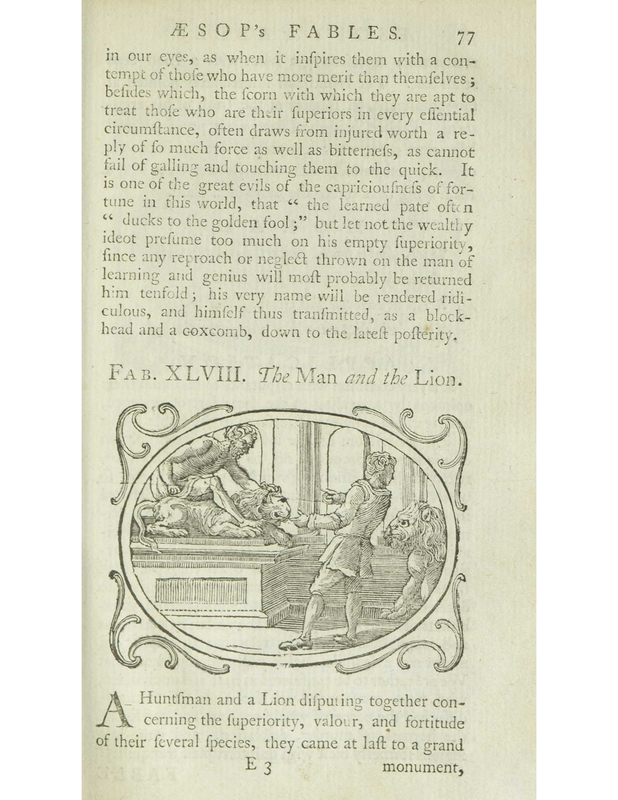
A man on the left side of the image pins down a lion beneath him on top of a platform, holding it down by its head. A man on the right points at the scene before him with another lion standing beside him, also staring at the man on the left. Both lions appear to be in distress.
there are two animals running through plants. The plants have long stems and berries on them. One animal is inside the plants, the other has not entered the plants.
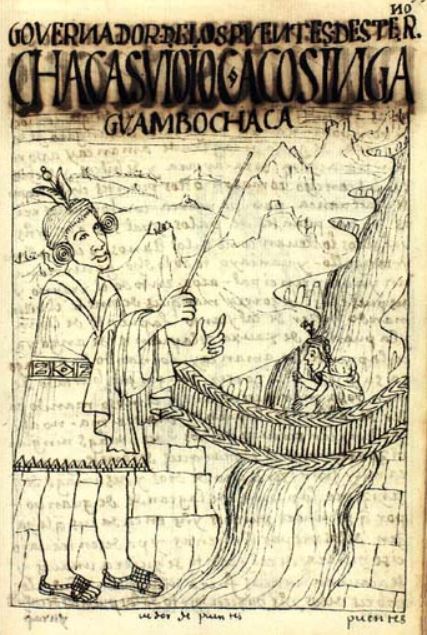
This chapter discusses the system of administrative officials in the Inca Empire. This image depicts an official overseeing the Huambo bridge. The author explains that all bridges within the Inca Empire were required to be overseen by an official. The man depicted in the image, Acos Inca, oversaw all the bridges. Acos Inca is illustrated standing on the left side of the image holding a stick in his right hand overlooking the Huambo bridge as a traveler walks across. The cable bridge is suspended over a long winding river surrounded by an Andean landscape. The caption at the bottom of the image reads “uedor de puentes” [of the bridges].
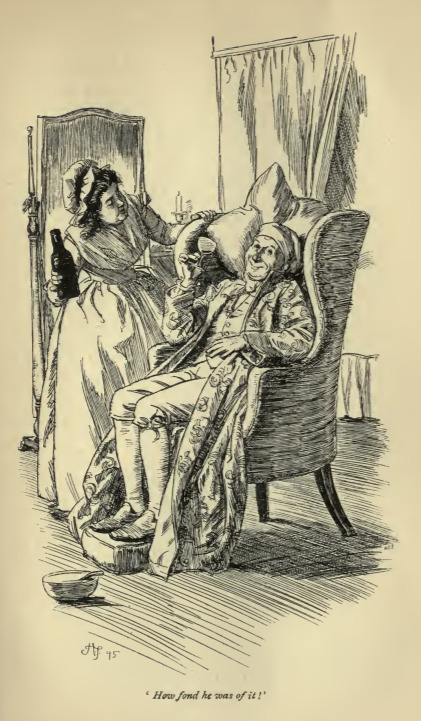
In this image Mrs. Jennings gives her ill husband a glass of her best Constantia wine. Mr. Jennings died before the beginning of the novel, but Mrs. Jennings spoke about him when caring for Marianne. After Marianne found out about Willoughby’s engagement, she was distraught. Mrs. Jennings was trying to care for her and brought out a glass of a special Constantia wine that always helped her husband when he was ill. Elinor told her that Marianne was already in bed but said she would drink it herself. This scene occurs in chapter 30. The characters are shown in the traditional regency style, as Mrs. Jennings wears the regency style dress with an empire waist. She has a mop cap to cover her hair and apron to protect her clothes. Her husband wears a waistcoat and breeches with a housecoat and nightcap. The regency period dated to the early nineteenth century (1811-1820) when George, Prince of Wales, later George IV (r. 1820-1830), reigned as regent for his mentally ill father, King George III (r. 1760-1820). The regency period is associated with the rise of neoclassicism in art and fashion.
In this image we see Gulliver standing next to a giant’s feet, looking up at the giant. Gulliver just comes up to the giant’s ankles, showing the scale between Gulliver and the giant. There are ropes around the giant’s ankles. The same image appears in the 1843 Krabbe edition.
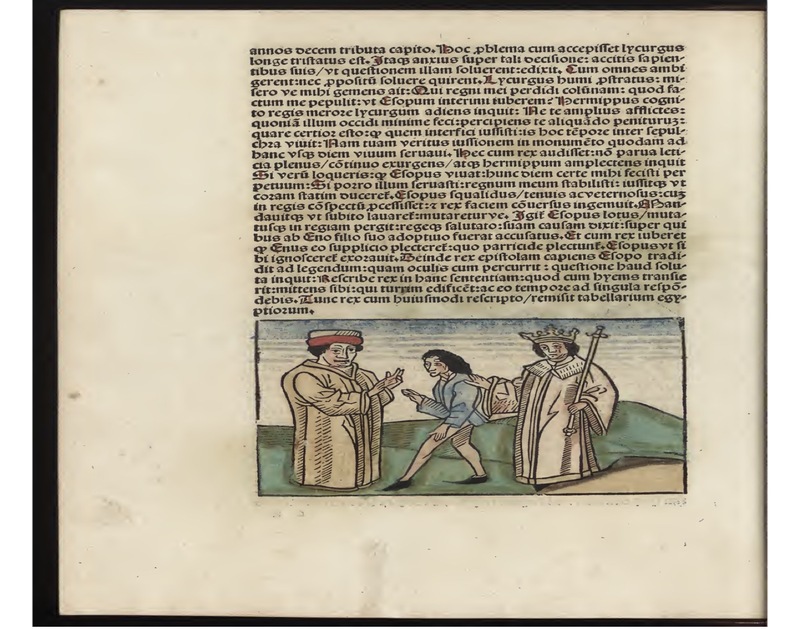
Three men stand together outside. A King has his hand on the shoulder of the man standing in the middle and holds in his other hand a sceptre. The third man is in conversation with the man in the middle and gestures with his hands towards him.
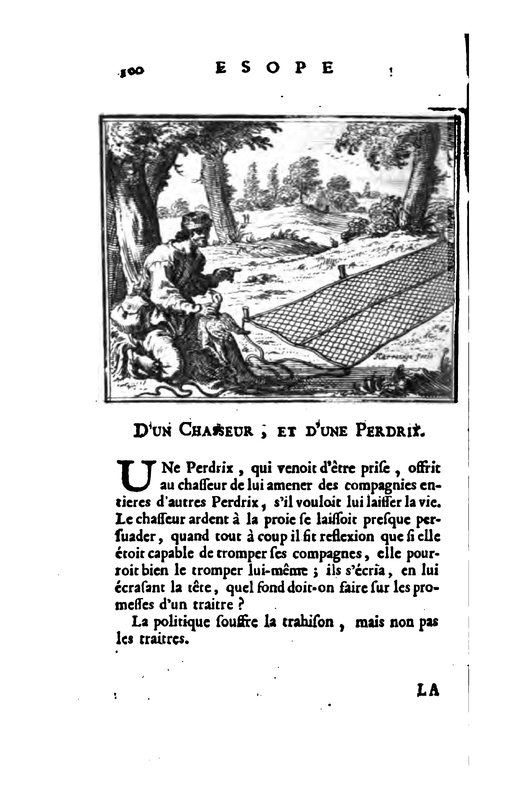
A partridge, which had just been caught, offered to bring the shoemaker whole companies of other partridges if he would let her live. The Shoemaker, eager for the prey, almost allowed himself to be persuaded, when suddenly he reflected that if she was capable of deceiving her companions, she might well deceive him himself; he cried out, crushing her head, "What proof should one give of the promises of a traitor?
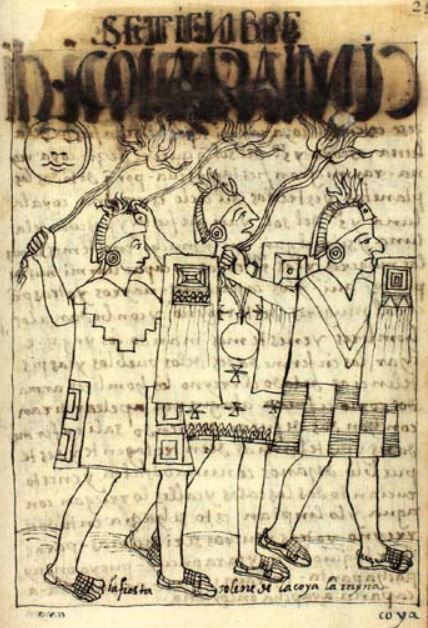
This chapter is dedicated to discussing the traditions and rituals of each month during the Inca Empire. The Incas tracked the months and years through the stars and their months consisted of thirty days. This image depicts the month of September, which was dedicated to holding a festival as a celebration of fertility and growth. The festival was dedicated to the Moon, which was the wife of the Sun. The author explains that the Inca Emperor ordered that sickness and disease to be banished in the kingdom during this time. To keep things clean and avoid sickness, warriors would walk with torches throughout cities and clean houses and the streets. There are three warriors depicted walking in this image with shields in their left hand and torches raised in their right as they walk towards a city to clean it. The Moon is depicted in the top left corner of the image. The caption at the bottom of the image reads “la fiesta solene de la coya la rreyna,” which translates to “the solemn festival of the coya the queen.”
A thin man walks along a raised path. He has his cane and free hand out in front of him, and behind him is a small town in the distance. In the top right of the image is the letter W from “We”.
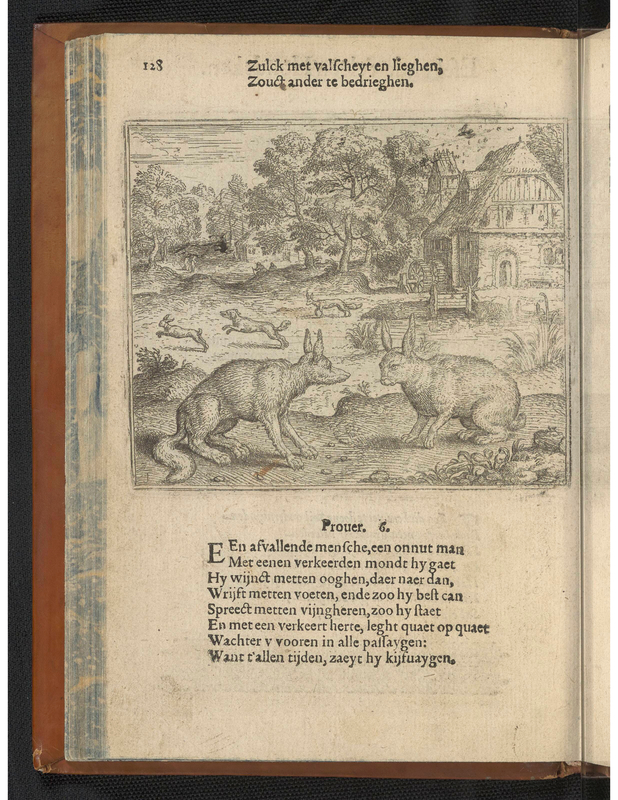
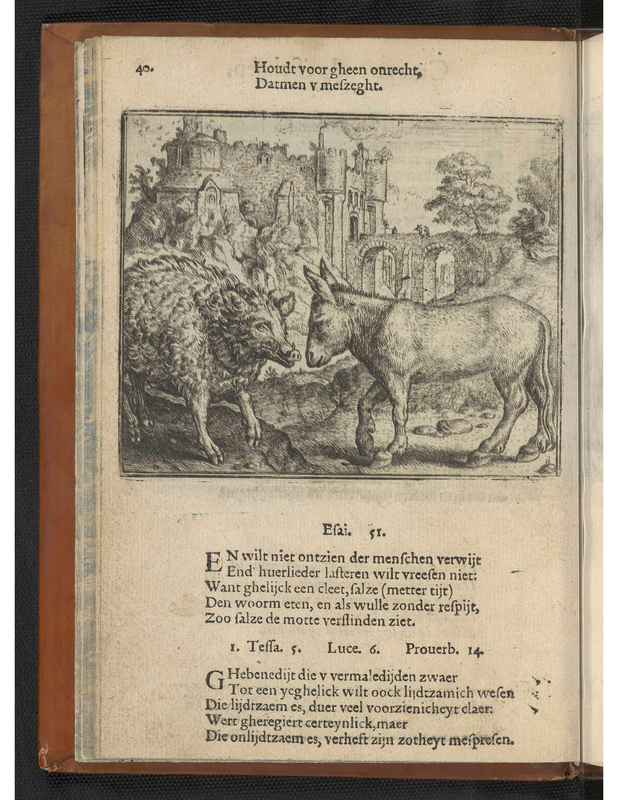
A donkey and boar stand in the foreground of the image. A large house is in the background. The donkey faces the boar, seeming to challenge him. On the left side of the page, the boar faces the donkey, leaning back.
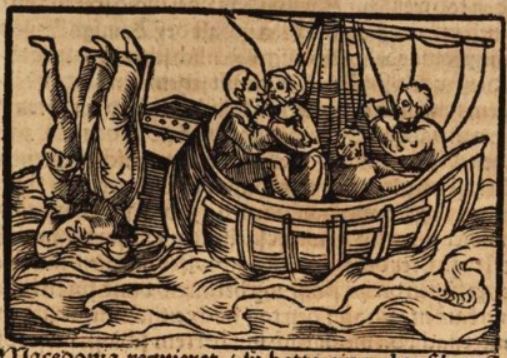
This engraving depicts Theoxena, her husband Poris, and her nephews and child killing themselves. Theoxena and her husband are depicted jumping from the ship head-first into the sea to drown themselves. They are illustrated holding each other as they die as a couple. The figures on the ship are her nephews and her son, who are also killing themselves. Theoxena had given them a choice between stabbing themselves with knives or to drink poison. Some of the children are depicted with knives in their hands as they kill themselves and one child is depicted drinking poison. Boccaccio explains that Theoxena and her family killed themselves to avoid dying at the hands of King Philip of Macedon.
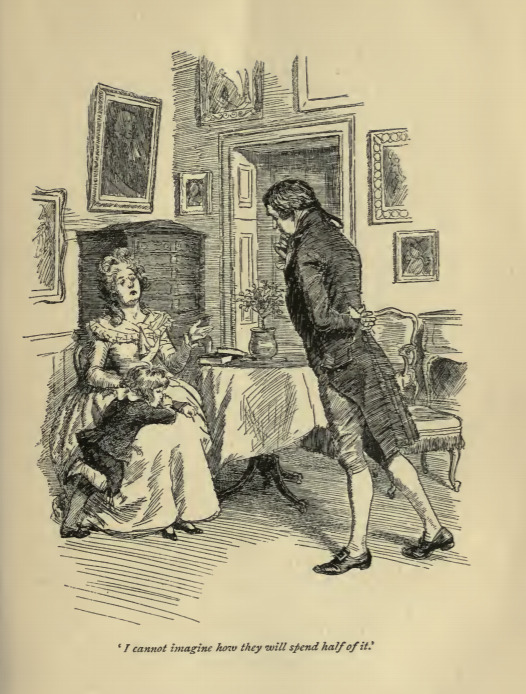
In this image we see Mr. John Dashwood and his wife, Fanny. John Dashwood was the sole inheritor of his father’s estate. He was supposed to use some of the money to support his half-sisters. Initially he was going to give them one thousand pounds, but his wife talked him out of giving them so much money. He settled on giving them a small amount of money on occasion, keeping the majority for himself and his family. This scene occurs in chapter 3. The characters are shown in the traditional regency style, as Fanny Dashwood wears the regency style dress with an empire waist. Her son is leaning on her knee. Mr. Dashwood wears a waistcoat and tailcoat with breeches and a cravat. The regency period dated to the early nineteenth century (1811-1820) when George, Prince of Wales, later George IV (r. 1820-1830), reigned as regent for his mentally ill father, King George III (r. 1760-1820). The regency period is associated with the rise of neoclassicism in art and fashion.
When Celestina (leftmost figure) arrives home with Pármeno (left-central figure), she tries to convince him to join her in scamming Calisto. She offers him a share of the profits and her prostitute Areusa (right-central figure), whom he loves, in exchange for his loyalty. He readily agrees, and she brings him to Areusa’s house, inducing them to spend the night together. She then returns home, where Elicia (rightmost figure) chastises her for the lateness of her arrival.[The figures in this illustration are used in multiple other illustrations throughout this edition.]
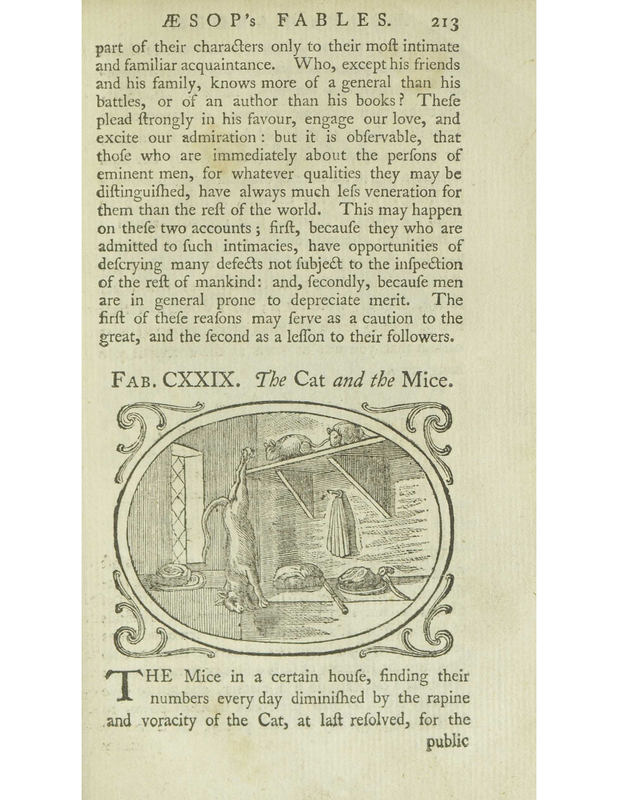
The scene is taken place outside. In the house there is a small window on the wall and a hat right below it to the right there is what looks like to be a bindle and another storage sack of some sort. Above that there is what looks like a cloth hanging from a ring and above that there is another shelf which two mice are sitting on top of, while a cat is jumping down from the shelf.
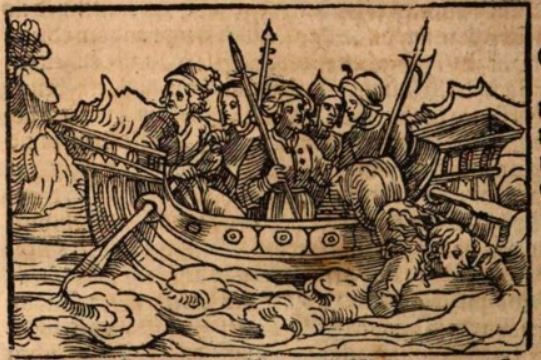
A Greek woman named Hippo had been captured by enemies, and when she heard them speaking of defiling her chastity, she decided that an early death was far better than having her honour destroyed. This engraving depicts Hippo on a boat surrounded by the men who had captured her. They are illustrated holding weapons such as lances and axes. Hippo is depicted aon the right side of the boat with her body plunging into the water. She drowned and successfully saved her honour.
Here we see Gulliver’s first encounter with the Lilliputians. We see the surprise on Gulliver’s face when he wakes up to the Lilliputians – who are one-twelfth his size – walking over him. Gulliver appears to be tied up by his hair. Several of the Lilliputians are armed, either with spears or bows and arrows. The same image appears in the 1843 Krabbe edition.
![[Finis]](https://collections.cemvc.ca/files/large/25ffc477fd18fa8a4c23a2190bf4697ab18a9e9e.jpg)

![[Gulliver arrives in the city of Lagado]](https://collections.cemvc.ca/files/large/539faca3783acdf034ac2d639d449752118ed861.jpg)
![[Gulliver raises his hat as the Emperor’s carriage drives away]](https://collections.cemvc.ca/files/large/c200fcff9e0ab352539dec59d6d91da4c471eb28.jpg)
![[Animal in plants]](https://collections.cemvc.ca/files/large/3ed3e4c4727cb4143f6e2693e6812eeb50579c7d.jpg)
![[Gulliver standing next to a giant’s feet]](https://collections.cemvc.ca/files/large/9ca53dc494de08f296fd3d696c855e6f62a37340.jpg)
![[Vanity Fair Vol. I Chapter XXX Inhabited Initial]](https://collections.cemvc.ca/files/large/cf771c346b6209e082e694d0adc7199423930014.jpg)
![[Act VII – Celestina, Sempronio, Areusa, and Elicia]](https://collections.cemvc.ca/files/large/ff0d38a1bd46c4b0e2b6a6a79fedfea3194366cc.jpg)
![[Gulliver’s discovery by the Lilliputians]](https://collections.cemvc.ca/files/large/a44c4154c5bd7a52ddb0b654dbc794e7552d5dca.jpg)