This image is a depiction of St Patrick’s Cathedral. Jonathan Swift was appointed dean of the Cathedral on 23 February 1713. The image is a part of Swift’s biography which precedes Part One of Gulliver’s Travels. The same image appears in the 1839 Krabbe edition.
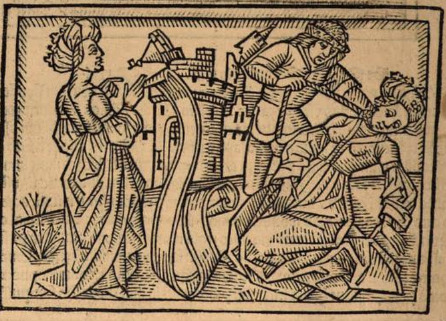
This engraving depicts Cassandra, the daughter of king Priam of Troy on the right side of the engraving being murdered. Clytemnestra is on the left side of the engraving ordering her servant to commit the murder. Boccaccio explains that Cassandra was brought to Mycenae after the Trojan War as king Agamemnon’s concubine. Agamemnon’s wife, Clytemnestra did not like this, and ordered Cassandra to be killed. Cassandra is depicted with a rope around her neck with the man pulling on the rope. Clytemnestra is depicted with a pleased look on her face as she watches Cassandra die. The fallen city of Troy is depicted in the background of the engraving.
Here we see a man falling over, drunk. This image appears when Gulliver explains wine to his master in the Country of the Houyhnhnms. Gulliver explains the effects of alcohol on humans, including drunkenness and hangovers. In this image we see a man leaning against the wall with bottles near his feet and a beer stein on the table in the background. The same image appears in the 1839 Krabbe edition.
When Celestina (central figure) returns home, she finds Sempronio (rightmost figure) waiting there with Elicia. She tells him that she has good news, but she makes him wait until they are with to hear it. They go to Calisto’s house together, and Pármeno (leftmost figure) sees them as they approach. He tells Calisto of their arrival, and Calisto orders him to open the door.The entire illustration is identical to the one found on page 27 of the text (folio b7r): [Act I (Third Illustration) – Celestina and Sempronio Talking as Crito Descends the Staircase].
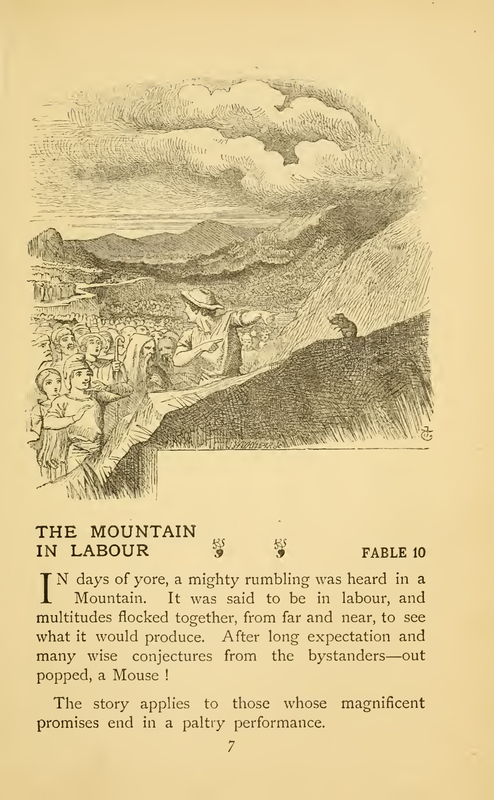
A large group of people are following a man. This man is pointing at what seems to be a mouse which is resting on the mountain. It is visible that there is a long line following behind the group of people. Large mountains and clouds are seen in the background.
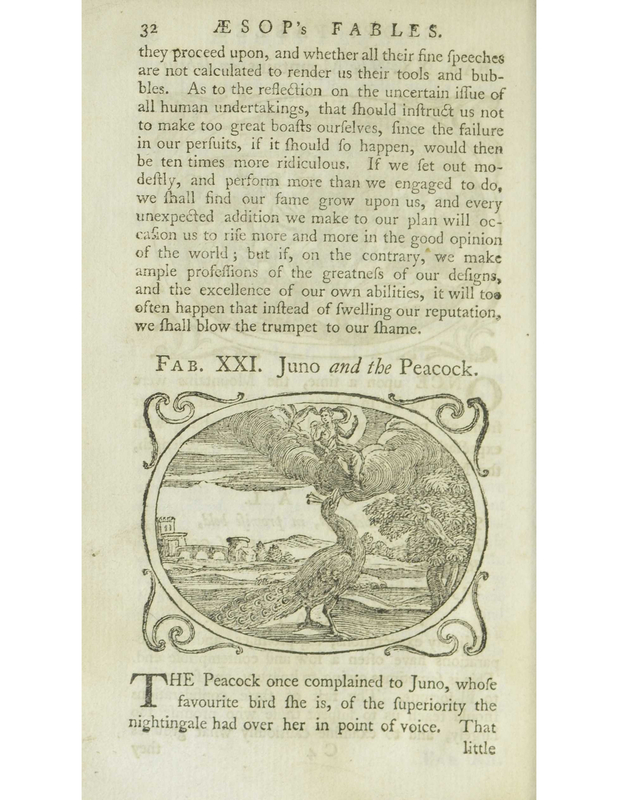
There is a peacock looking up to a god like person in the clouds, in the sky. A nightingale is off to the right side of the image, perched in a tree with lots of foliage. The nightingale is also looking up to the sky. In the background scene, there is a castle and bridge to the left of the image, with hills and terrain moving to the right of the image. Behind the individual in the clouds there appears to be a brighter spot in the clouds. The individual appears to be wrapped in a robe like cloth. There is some sort of material or object floating behind the individual, in a long, wavy horizontal shape.
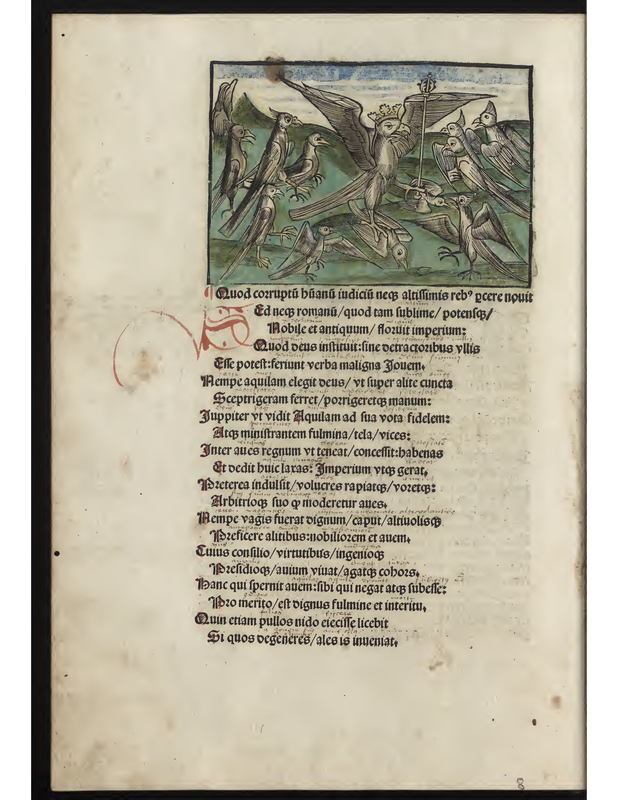
A big black bird wearing a crown with an intricate staff appears to be the king of a group of birds. The bird king is standing on two smaller birds and talking to the rest of the birds with his wings spread high. The other birds, who are all the same species as the bird king but smaller, gather around the bird king.
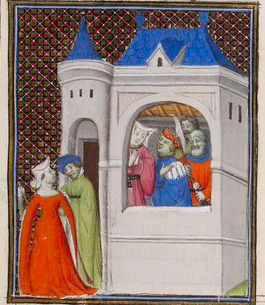
When the Minyan men committed crime, they were sent to jail and ordered to be put to death. Their wives, the Minyan women, had a plan – they would take their husband’s places in jail. When the wives went to visit their husbands, they immediately switched clothing with them, allowing the husbands to escape without being caught. This is represented in the photo, with the men escaping in their wives’ clothing on the left, and the wives in jail in their husbands’ clothing on the right.
After Sosia informs Tristan that Sempronio and Pármeno are dead, they go and wake Calisto to inform him of the news. Sosia tells him that they have been decapitated by the executioner on the order of the justice (the ‘alguacil’). Calisto is struck with grief, and he asks Sosia to tell him the reason for their execution. Sosia explains that they were guilty of murdering Celestina because she would not share the gold chain that Calisto had given her. This image depicts the decapitation scene. Pármeno appears to have been beheaded first (his head is in the bottom right corner), while Sempronio is on his knees awaiting his fate. The executioner has his right hand placed on Sempronio’s head, and his sword is drawn upward in his left hand. Something odd is happening around the executioner's waist, making it appear connected to the background (likely through a printing/engraving error). There are three figures to the right of the image, perhaps the alguacil’s men (although one of them may be Sosia). One is riding a horse, and another is standing with a spear of some sort in his right hand. The central of these three figures is odd, since everything below his collarbone appears to be missing (also likely through a printing/engraving error). These three figures are all wearing hats. Immediately behind the executioner we see what appears to be gallows, and to the left of this we see buildings.
There are two birds staring at each other while food or eggs lay in the middle of them. One of the birds resembles a peacock while the other resembles a crane.
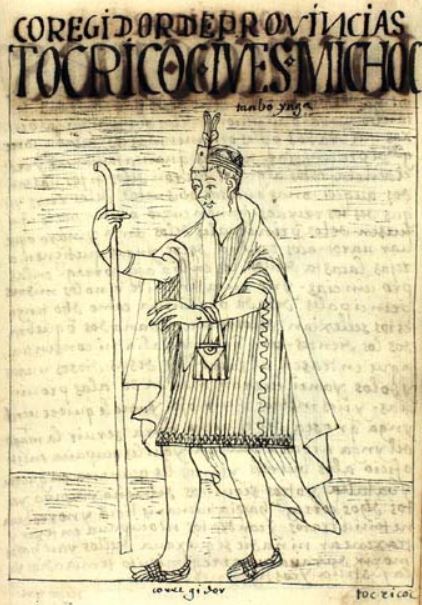
This chapter discusses the system of administrative officials in the Inca Empire. This image depicts a provincial district official holding a walking stick in his right hand and carrying a small bag on his left wrist. The author explains that these officials were from the lineage of Tambo Inca (this name is written above the official's head) and those of this lineage usually had physical deformities on their ears, hands or feet. This official appears to have a deformity on his ear. These officials were chosen to enforce the law as they were not fit for war due to their deformities.
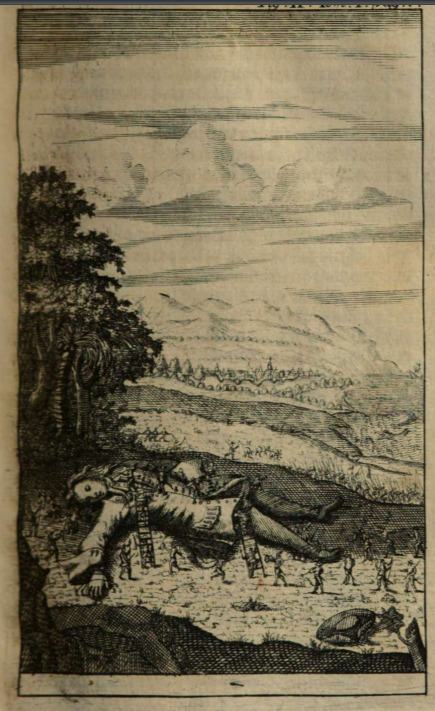
The image depicts Gulliver’s first encounter with the Lilliputians. Gulliver is in the foreground, laying on the ground, tied at the wrists and ankles. There are two ladders leaning against Gulliver, one against his chest, another leaning on his leg, that the Lilliputians use to examine Gulliver. Gulliver is surrounded by the Lilliputians, who are 1/12th of his size. Several of the Lilliputians hold bows and arrows. Gulliver’s hat is on the ground by his feet. Several large trees are near Gulliver’s head. In the background, the town is visible, with the sky taking up the top third of the image.
It is not entirely clear what this image depicts, but it likely shows a North African soldier cowering in fear of the Cid. He is crouching in shadow underneath a draped cloth, with his sword still in its sheath.
Here we see one of the inflated bladders used by Flappers on Laputa. These bladders were filled with peas or pebbles and were used to communicate. Laputan scholars would become so involved in their work they could not speak, hear, or see what was in front of them. It was the role of the Flapper to tap the scholar gently on either the mouth, ear, or eyes to communicate information to them, and distract them from their work. In this image we see the bladder with astronomical and musical motifs, and the stick that it was attached to. The Flapper would stand or walk behind the scholar and carry the bladder, often holding the bladder over the shoulder of the scholar. The same image appears in the 1839 Krabbe edition.
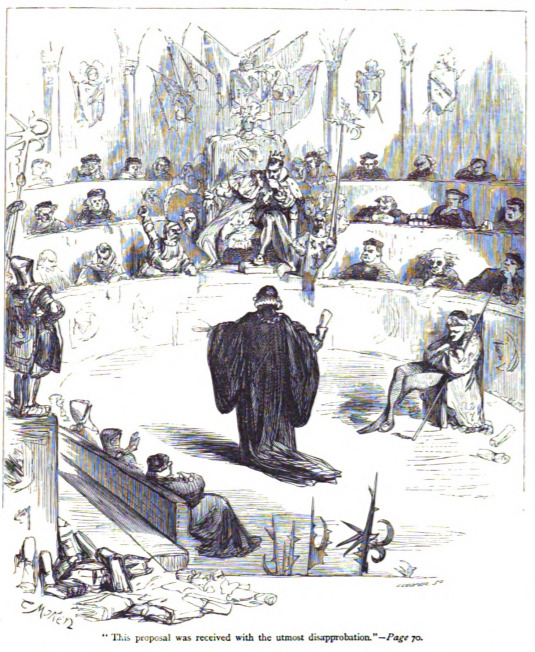
Here the secretary of state of Lilliput addresses the Emperor, suggesting an alternative punishment to death for Gulliver. In the stands we see the other members of Parliament who look disapproving. The Emperor seated in the centre. To the left of the Emperor the admiral stands waving his arm in outrage at the proposal.
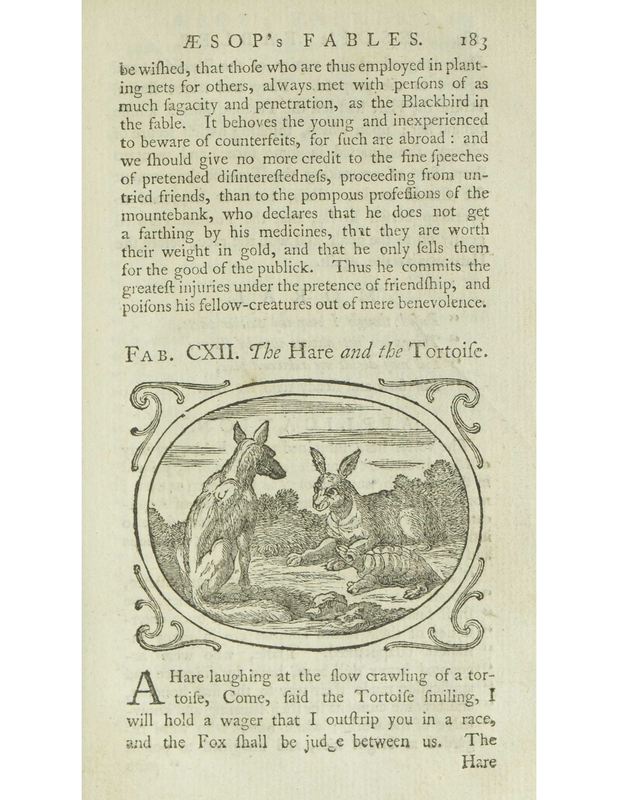
A fox sits facing away from the viewer, looking to its right. Looking back at the fox is a hare laying on the ground. Next to the hare is a tortoise on the ground, looking up at the fox. There are bushes around the animals.
Hans kneels outside the door to Rebecca Crawley’s room at the Elephant Hotel, pleading for her to dine with him and Fitz later that day. Joseph Sedley is behind him, having just come up the stairs to see Becky, speechless in surprise.
"A man is on the left side of the image and is unlocked the door to a castle while also holding a watering can or a similar looking object. The man is also wearing a hat. Inside the castle on the right side of the page are two rats."
This image depicts a native Peruvian astrologer walking in front of a mountainous Andean landscape. He is using a walking stick with his right hand and holding a quipu in his left. A quipu was a stringed Incan device used to record and keep information. He is depicted wearing a hat and carrying a bag around his chest. The astrologers would study the sun, moon and stars to better determine when would be the best time to sow the fields for a good yield. The caption at the bottom of the image reads, “astrologo” [astrologer].
Here we see a depiction of the corruption of the English legal system. The image shows a desk with bribes on top of the verdict. A framed picture of a lawyer is in the back. We see a rabbit and several bottles, likely of expensive goods, and a coin purse with coins spilling out on top of a stack of papers, with the word “verdict” written on it. Gulliver tells the King about diplomacy, religion, the justice system, the arts, the financial system, and the nobility, then debated these issues with the king. This image comes when Gulliver is discussing the corrupt legal system, speaking to how the wealthy could buy their desired outcome. The same image appears in the 1843 Krabbe edition.
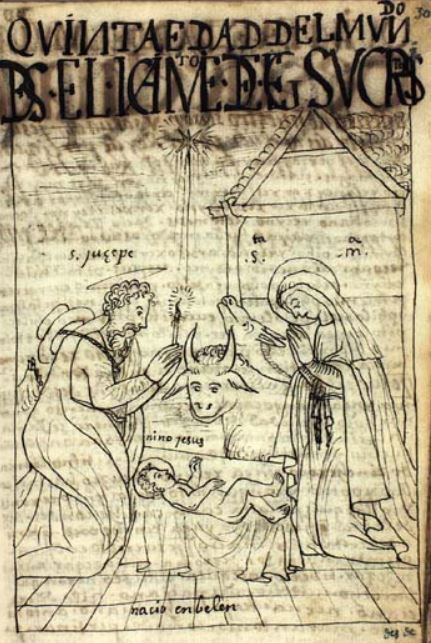
This illustration depicts the birth of Jesus Christ. He is depicted in the centre of the image with the words “nino jesus” written above him, which translates to “baby jesus.” His parents, Mary and Joseph are illustrated looking over him with their hands together in prayer. There is a barn and barn animal illustrated in the image as well. The star of Bethlehem is illustrated in the sky above baby Jesus. The words “nacio en belen” are written at the bottom of the image, which translates to “born in Bethlehem.”
A An Indigenous male is pictured standing on a hill, from the front and from behind. He wears beaded necklaces, beads around his left wrist and a cuff/wrist guard on his right, and fabric in the fasion of a fringed skirt tied around his waist. He is barefoot and shirtless, carries a longbow, and wears a quiver of arrows around his waist. In the background behind him there is a group of Indigenous people also holding longbows, and four people hunt deer. A forest is visible in the background.

![[St Patrick’s Cathedral]](https://collections.cemvc.ca/files/large/d14e6c8f1dd38885a3484cdc8f4c9b7d21116f52.jpg)
![[A drunk man]](https://collections.cemvc.ca/files/large/6ea5ff421f5e583123fab5e5f2c374a675e2721e.jpg)
![[Act V – Pármeno Opening the Door for Celestina and Sempronio]](https://collections.cemvc.ca/files/large/9892a8eb6136fb230d1fdc5642c774db6ecf4917.jpg)
![[Act XIII – Sempronio and Pármeno are Executed for the Murder of Celestina]](https://collections.cemvc.ca/files/large/050dbe3a9d1bdf14f56898e2f4bc54a4424b7901.jpg)
![[Two Birds Staring]](https://collections.cemvc.ca/files/large/628c97291285258aa642ad6d92a161809a1863c8.jpg)
![[“Moors and Christians all do hold in terror great my sword.”]](https://collections.cemvc.ca/files/large/bec9cc407386163292edec1a2a20cf4191c7b5f4.jpg)
![[Inflated bladder used by Flappers on Laputa]](https://collections.cemvc.ca/files/large/820b2a96216924078df7006d2d8979c2590dc307.jpg)
![[Hans at Becky’s Door]](https://collections.cemvc.ca/files/large/a0e66803b701be7f9e865ae6580375c8ccedc876.jpg)
![[A Man and a Rat Castle]](https://collections.cemvc.ca/files/large/c7b61e1fcd26b242a52e989fef0ce8b5e3d9aac0.jpg)
![Astrologo, Pveta Q[ve] Save Del Ruedo Del Sol y de la Luna y [E]clip[se] y de Estrellas y Cometas Ora, Domingo y Mes y Ano y de los Quatro Uientos Del Mundo Para Senbrar la Comida Desde Antigua](https://collections.cemvc.ca/files/large/f5f57b4064fbf79c528df0eadf22dae828d988f7.jpg)
![[depiction of the corruption of English Legal system]](https://collections.cemvc.ca/files/large/92d67ef37513f40832073cffe03ca00c7c959424.jpg)