This image is illustrated in a chapter that discusses the Christian priests in the colonial government in Peru. This image depicts a dinner party with a Spanish priest presiding over it at the head of the table on the right side. He is dressed in ecclesiastic adornments as he takes a drink from his cup. A Spaniard is depicted to the priest’s right, while two indigenous men stand to his right. There is a small indigenous figure pouring a drink into the cup of one of the dinner guests.
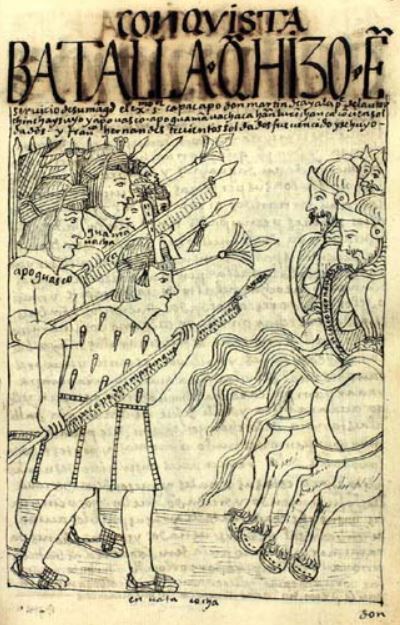
This chapter focuses on discussing the arrival of Spaniards and the Spanish conquest of Peru. This image depicts a major battle between Francisco Hernandez Giron, a traitor to the Spanish crown, and noble lords that are indigenous to Peru. The left side of the image depicts the side of those fighting in the service of the king. Their names are written on their bodies to identify them. The man at the forefront of the image holding a spear is identified as “capac apo don martin mallqui de ayala.” The man behind him is identified as “apo guasco” [Apo Huasco/Wasco], and the man behind him is identified as “guaman uacha” [Guaman Huacha/Wacha]. The author explains that this army only consisted of one hundred indigenous soldiers, while Francisco Hernandez Giron’s side had 300 Spanish soldiers and one hundred mestizos. Despite being heavily outnumbered, the noble lords won the battle. The right side of the image depicts Francisco Hernandez Giron and his men fleeing battle while riding their horses and looking back to the opposing army in fear. The caption at the bottom of the image reads, “en uata cocha” [in Huatococha].
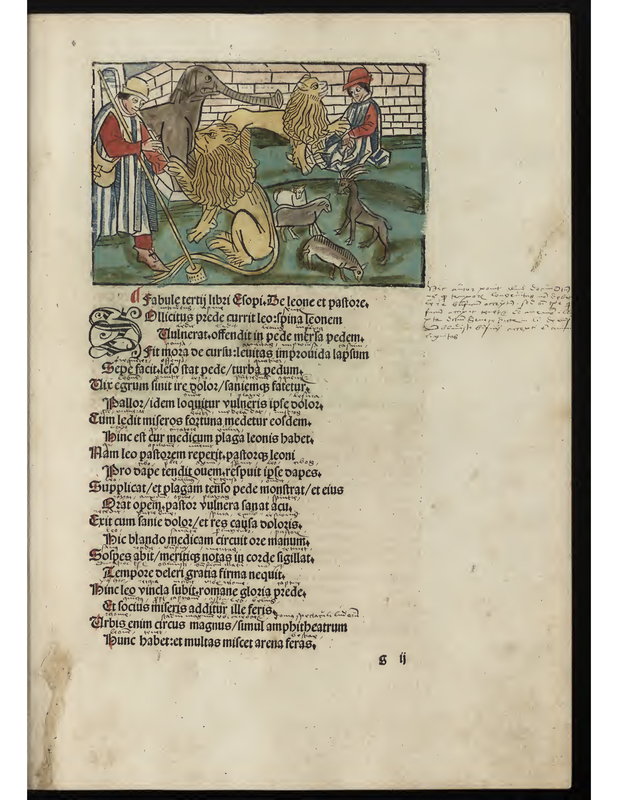
Two lions are interacting in a friendly way with their handlers while an elephant is seen in the background. Three lambs and a goat are also depicted to the right of the image.
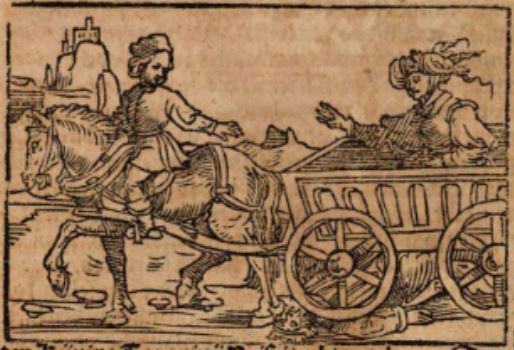
This engraving is unique as it was not an actual story included in Boccaccio’s original book. The engraver and compiler of this edition appear to have included this image and story as it relates to the subsequent description about the Roman woman Lucretia. This image depicts Tullia, the husband of Lucius Tarquinius Superbus, and daughter of Servius Tullius. Tullia had helped her husband overthrow her father off the throne as the king of Rome in order to place her husband on the throne. Lucius Tarquinius Superbus had Servius Tullius assassinated, and his body was thrown into the streets where Tullia then ran his body over with a chariot. This image depicts this event, as Tullia is depicted riding in a horse drawn chariot as it crushes her father’s body underneath.
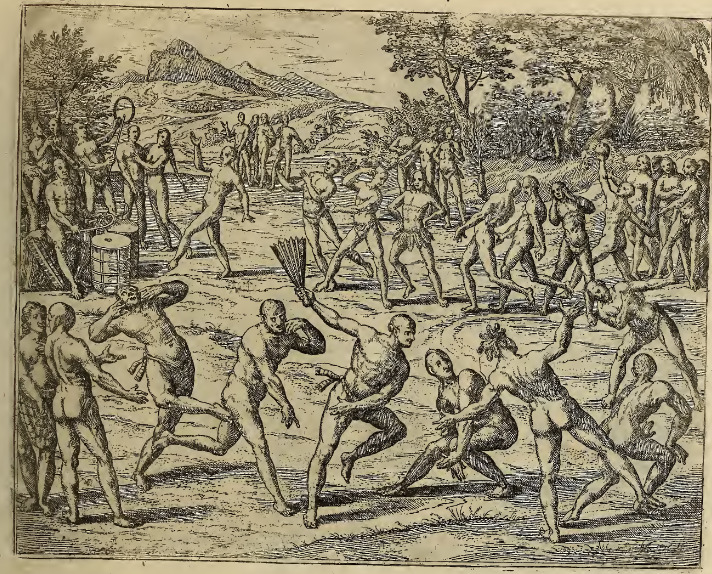
A group of Indigenous people in Nicaragua participate in festivities. Many dance and leap across the ground together. Several people on the left play musical instruments, including drums, a horn, and tambourines or rattles. Most individuals are nude, with some wearing loincloths, feathered skirts, or feathered headdresses. One man holds a fan of feathers in the air as he dances.
This illumination depicts Portia, the daughter of Marcus Cato and the wife of Brutus, swallowing a hot piece of coal to kill herself. Brutus was one of the people involved in the conspiracy to assassinate Julius Caesar. When Brutus told Portia of the conspiracy, she took a barber’s knife and stabbed her foot with it. She does this to prepare herself in case she has to kill herself should the conspiracy not work out in Brutus’ favour. Brutus eventually dies, and all Portia had to kill herself with was hot coal which is why she is depicted swallowing this in the image.
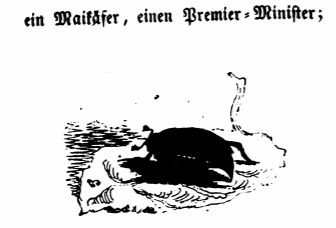
This image is of a beetle. A buzzard was the code word for the Prime Minister. This image comes in a description of a conspiracy found by a professor from the Grand Academy on Balnibarbi. This idea is representing code word for terms in the conspiracy that Swift is satirizing. The professor advises that those named in the conspiracy papers be closely monitored at all times, naming specifically while they were using the bathroom, as this is when men were most thoughtful. This conspiracy is thought to be an allusion to the trial of Francis Atterbury, the bishop of Rochester for allegedly plotting with the Jacobites. Atterbury was charged with treason in 1722 and was exiled to France. The same image appears in the 1843 Krabbe edition.
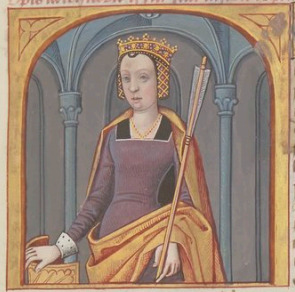
This illuminated image depicts a portrait of Opis (also called Ops). She is standing upright, wearing a crown and holding a scepter in her left hand. Boccaccio explains that Opis was the wife of Saturn, and she is renowned for having saved her children from his wrath. A prophecy had foretold that her children, Jupiter, Neptune, and Pluto would eventually defeat Saturn. To avoid this from happening, Saturn planned to kill them. Opis saved her children from her husband which is why Boccaccio wrote on her.
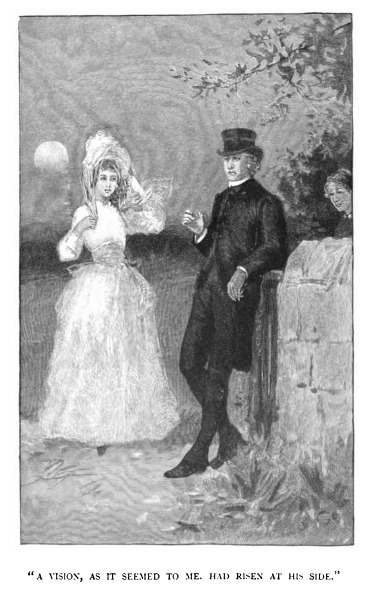
Here we see Mr. Rivers with a young woman, standing outside the wall of the schoolhouse in Morton. After arriving in Morton, Mr. Rivers gave Jane a job working as the schoolmistress. The woman standing with Mr. Rivers is Miss Olivia, the donor for the school. She asked to come visit the school and help Jane with teaching.
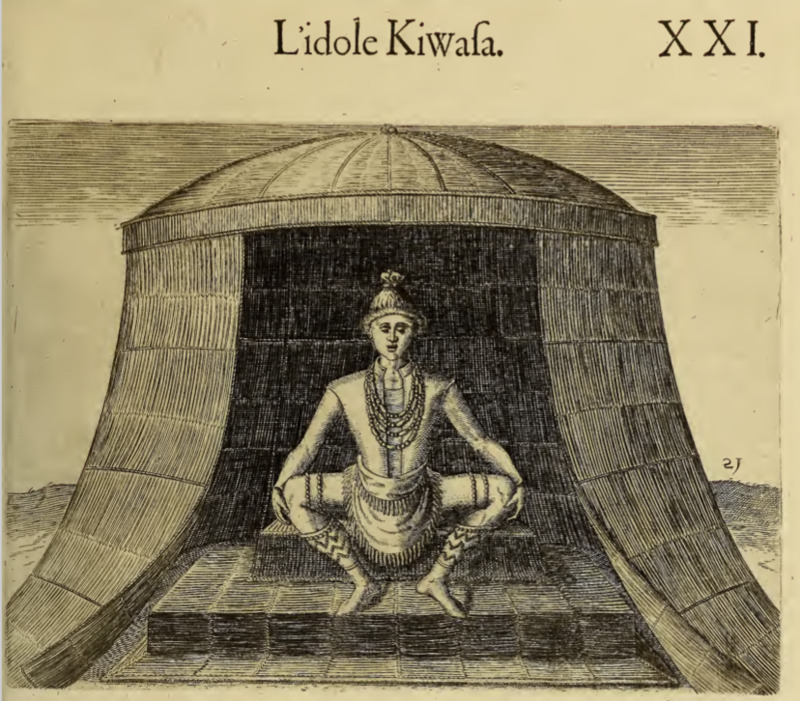
An idol carved of wood is pictured. It is shaped like a human man in a seated position and sits inside a hut-like structure. The idol bears a hat, strands of beads around its neck, a fringed skirt around its waist, strands of beads around each of its thighs, and decorated cuffs around each of its calves.
The Houyhnhnms were astonished that the only skin visible on Gulliver was on his hands and face, as the yahoos were completely naked. This served as a distinction between Gulliver and the other yahoos. It was Gulliver’s custom to undress at night and cover himself with his clothes. His master’s valet walked in on Gulliver while he was sleeping, and his clothes had fallen off and discovered that Gulliver’s body was the same as the yahoos. His master was astonished by this, and Gulliver explained how clothing worked. Gulliver asked him to keep this information to himself. The same image appears in both the 1839 and 1843 Krabbe editions.
Three horned figures in sashes and pointed hats, holding poles, stand in formation before buildings with curved roofs. In the top right corner of the image is the letter T from “The”.
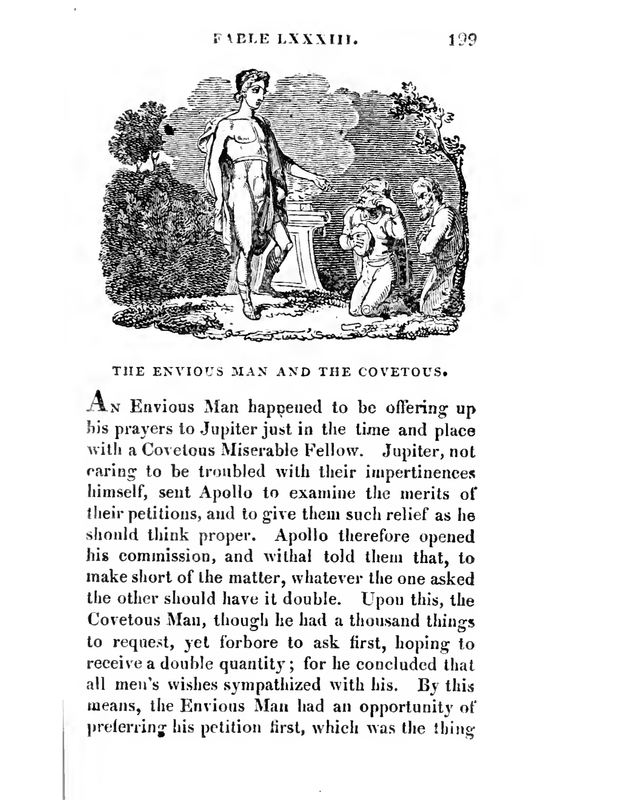
In the middle of the image, there is a man standing up in front of some type of structure. On the right side of the image there are many trees, bushes, and plants. On the right side of the image there are two other men kneeling on the ground. The man closest to the man in the middle is holding something in one hand while he looks upwards, and the man furthest away is looking downward. On the far-right side of the image there is also a tree that leans slightly over the two men that are kneeling.
A lord of Balnibarbi shows Gulliver around the estate. On his tour he took Gulliver to this old mill. The academy wanted to move the mill upstream, and although the lord was not enthralled with the idea, he reluctantly agreed, pressured by his friends. The new mill failed, and the lord was blamed. The same image appears in the 1839 Krabbe edition.
After spending the night with Areusa, Pármeno wakes up to find that it is midday. Areusa asks him to stay and talk, but he feels concern that his master Calisto will be upset with his absence. He tells her that they will have plenty of time to talk later, and asks her to join him for supper at Celestina’s house later that night. She is pleased by this suggestion, and he departs (to the left he is seen leaving). When Pármeno arrives at Calisto’s house, he is greeted by Sempronio, who chides him for his lateness (seen to the right). Pármeno reveals to Sempronio the reason for his lateness, and explains his love for Areusa.Every male figure in this image is depicted wearing a hat. Unlike most other illustrations in this edition, none of the male figures appear to have swords. Areusa, the leftmost figure, is wearing a robe and a veil while sitting on her bed.
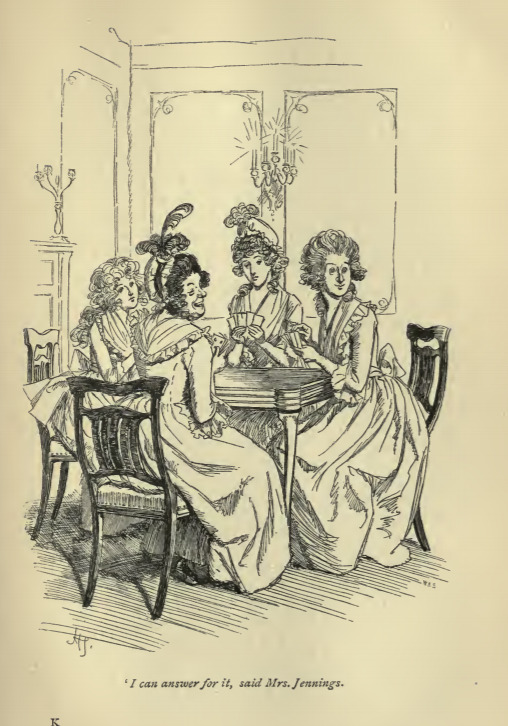
In this image Mrs. Jennings, Lady Middleton, Lucy Steele, and Elinor play cards at Barton Park. The group discuss Edward Ferrars, poking fun at Elinor, not knowing that Lucy was engaged to him. Mrs. Jennings says that she can answer for Edward’s character, joking about Edward’s being a good humoured and handsome man and Elinor had chosen well. Mrs. Jennings continued that no one had any idea who Lucy was interested in because she was such a “sly creature.” This scene occurs in chapter 24. The characters are shown in the traditional regency style, as the women wear the regency style dress with an empire waist. The regency period dated to the early nineteenth century (1811-1820) when George, Prince of Wales, later George IV (r. 1820-1830), reigned as regent for his mentally ill father, King George III (r. 1760-1820). The regency period is associated with the rise of neoclassicism in art and fashion.
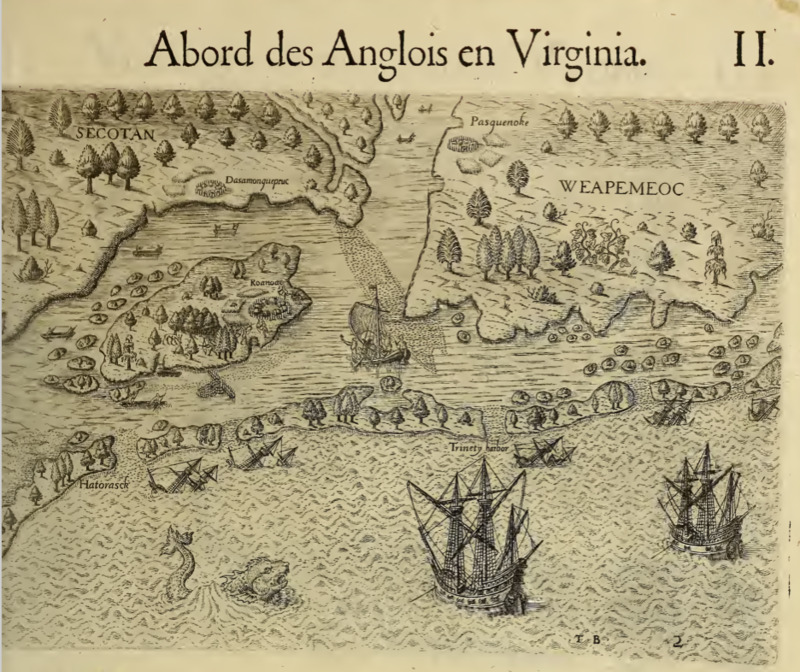
Two English ships are pictured sailing near the coast of Virginia (what is known today as the Outer Banks of North Carolina). One smaller ship is pictured within the outer islands, closer to the coast. Several Indigenous towns are labelled.
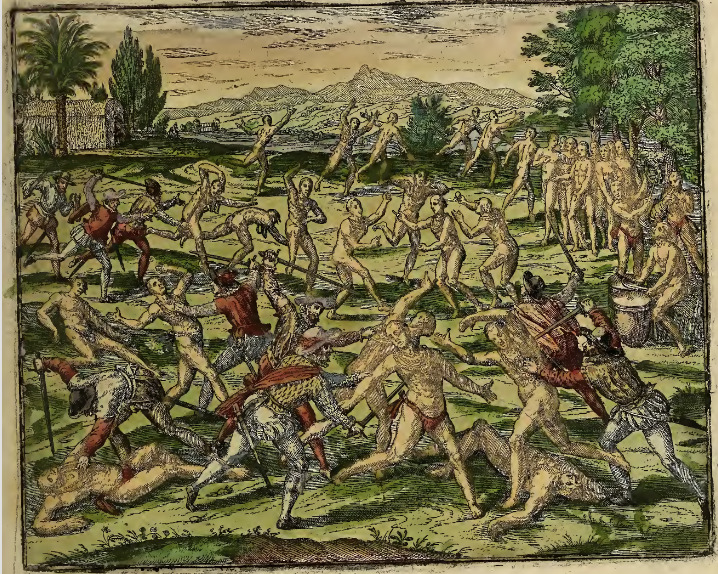
Hernan Cortés and the Spanish soldiers under his command occupied Tenochtitlan (Mexico City) in 1519. Cortés eventually left the city, leaving Pedro Alvarado in command. During an Indigenous festival the Spaniards attacked the Indigenous people out of greed, stealing the gold jewelry they had donned for the festivities. Here, Spanish men chase and grapple with unarmed Indigenous people, attacking them with swords and clutching at the gold necklaces they wear. At the edge of the skirmish, three Indigenous people still hold the musical instruments they played during the festival. A small group watches the violence on the right, while several others flee. One structure is visible in the background. This image is identical to one found on page 153 of Frankfurt, 1595, but colored.

![Conbida P[adr]e a los Borachos Yndios Uajos, Mestizos, Mulatos, Para Tener Parte de Rrobar a los Yndios Pobres](https://collections.cemvc.ca/files/large/e3626152bf10c36fbf9a6d50852f9c6c4e406611.jpg)

![[The Houyhnhnms discover how Gulliver’s clothes work]](https://collections.cemvc.ca/files/large/facdfb6afe08d0bec67c0a12862e091fddc94dac.jpg)
![[Vanity Fair Volume II. Chapter V Inhabited Initial, T]](https://collections.cemvc.ca/files/large/2751a41c277e6884189d56abd6ac5dc0ddd93aa9.jpg)
![[A broken down mill outside of Lagado]](https://collections.cemvc.ca/files/large/03b9a349b40abe8c5886205d6052464674d8b234.jpg)
![[Act VIII] Pármeno spreect tot Areusa syn lief.](https://collections.cemvc.ca/files/large/c3a0ce2d71ad2d813021b4386a4a1eec11f59a6a.jpg)