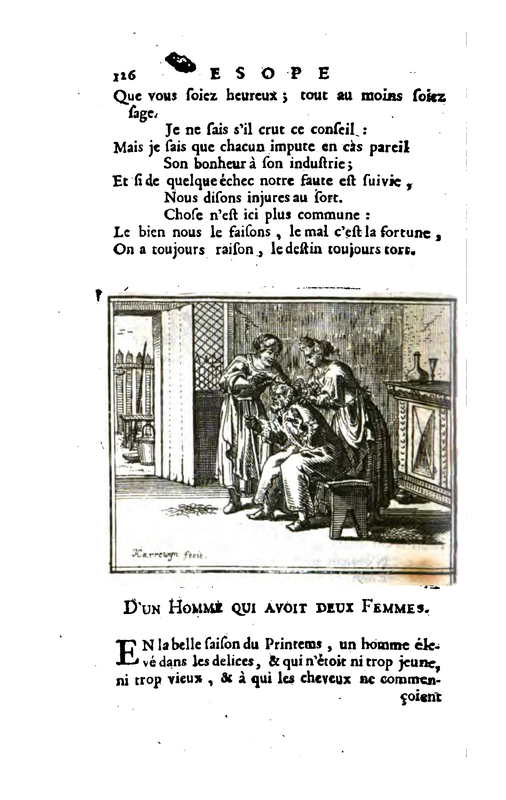
A man had one wife that was old and one that was young; each loved him and wanted him to look like herself. The mans hair was turning grey, which the young wife did not like, as it made him look too old. So, every night she plucked out the grey hairs. But, the elder wife did not like to bee mistaken for his mother. So, every morning she plucked out as many black hairs as she could. The man soon found himself entirely bald.
Here we see Gulliver standing behind a folding razor which was used by the King of Brobdingnag’s barber during the morning ceremony called the Levee. The Levee was a daily ceremony that originated in France and spread to other monarchies quickly thereafter. Gulliver attended the Levee and asked to take the soap with the King’s beard hair which he then used to make himself a new comb. In the image we see the bar of soap used on the bottom right corner, labeled “savou”. On the handle of the blade is the letter “J”, which is the first letter of the chapter. The same image appears in the 1843 Krabbe edition.
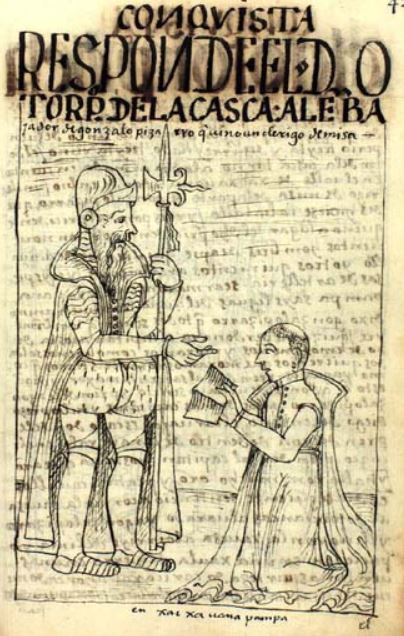
This chapter focuses on discussing the arrival of Spaniards and the Spanish conquest of Peru. This image depicts Pedro de la Gasca, the Spanish Viceroy of Peru, receiving a cleric that was sent by a conquistador named Gonzalo Pizarro. Gonzalo Pizarro rebelled against King Charles V of Spain, and Pedro de la Gasca was sent by the king to make peace with Pizarro. When Pizarro refused to co-operate, Pedro de la Gasca prepared for battle against him. Pizarro sent Gasca a cleric, as depicted in the image, to request that war not be made. The clergyman is illustrated presenting a letter and kneeling before Pedro de la Gasca. Gasca is illustrated standing in front of the clergyman with his hand reaching towards the letter. He is depicted wearing a full suit of armour and holding a long spear in his left hand. The caption at the bottom of the image reads, “en Xacxauana Pampa” [at Jaquijahuana].
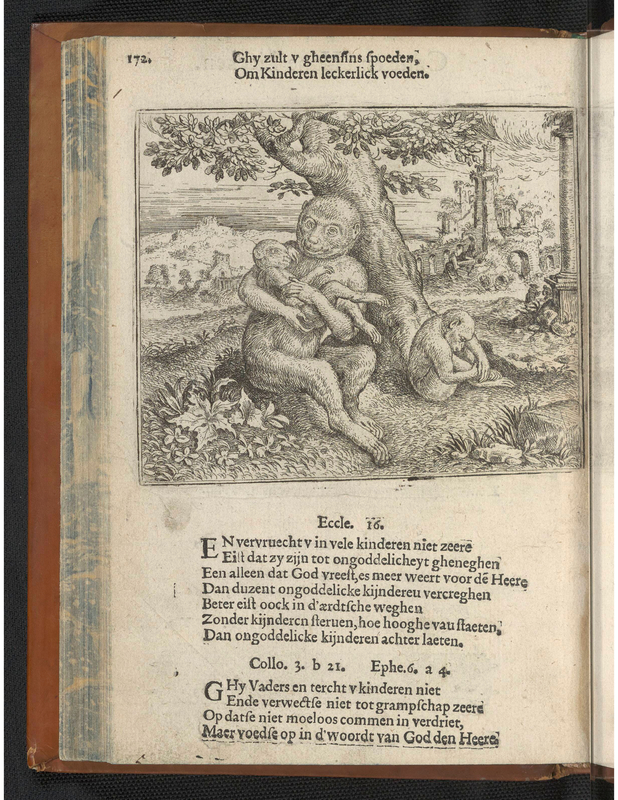
A monkey sits under a tree with a newborn monkey in its arms; in the background a second youngster sits under the tree at right; in the upper right corner there are classical ruins.
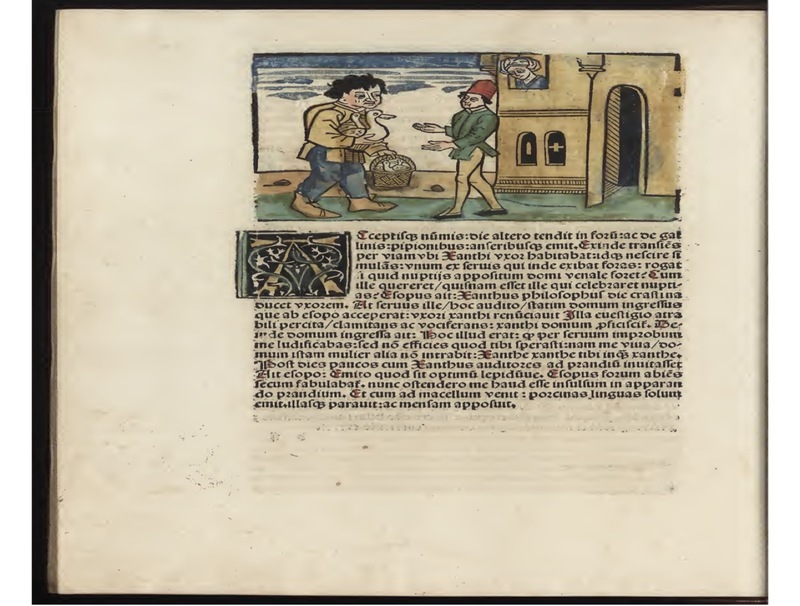
Two men stand talking outside a castle. One of the men, Aesop, carries two large ducks in his arms and a basket of ducklings, which he appears to be giving to the other man. A woman looks down sadly from inside the window of the castle.
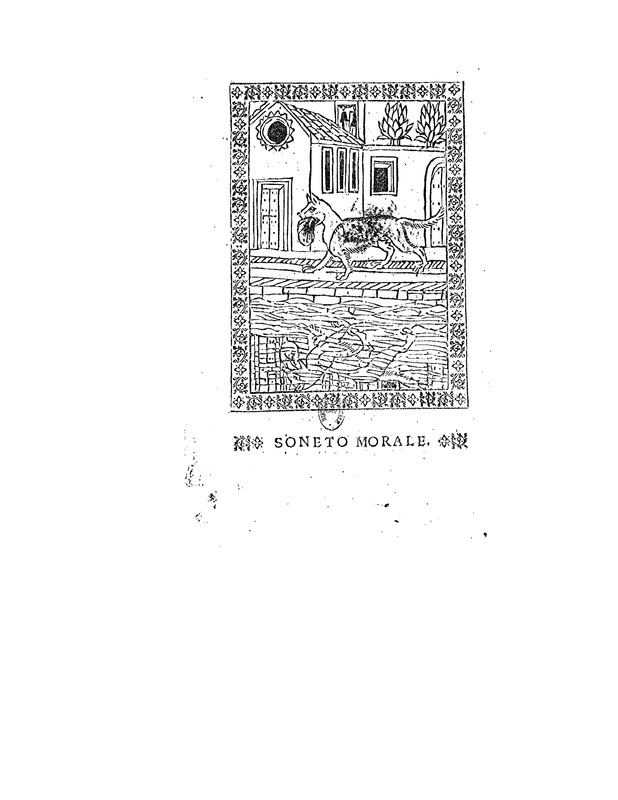
In the centre of the image there is a dog that is walking across a bridge or some kind of platform above water. The dogs reflection is depicted below it, the dog is looking at its reflection.
This illumination depicts a woman named Sempronia on the right side of the image wearing a red dress. Sempronia was the daughter of the famous Tiberius Gracchus. Boccaccio explains that after her brothers were murdered, Sempronia was brought to trial by a tribune of plebeians. This image depicts that trial. The person on the left side of the image told her to let herself be kissed by a man named Equitius (who is wearing white and standing in front of Sempronia) and accept him as a member of the Sempronian family, however, Sempronia rejects this to protect her family’s honour and nobility. There is a person placing their hand on Sempronia’s back as they urge her towards Equitius. Boccaccio explains that he wrote on Sempronia to highlight her courage and bravery in this situation.
In chapter five, Gulliver explains several aspects of society in England. Here we see several animals dressed in legal robes. Most animals were birds, with one donkey. This image serves as a commentary on the legal system, and its inefficiencies. The animals represent the ignorance, stupidity, and lack of common sense that Gulliver saw in the legal system. The same image appears in the 1839 Krabbe edition.
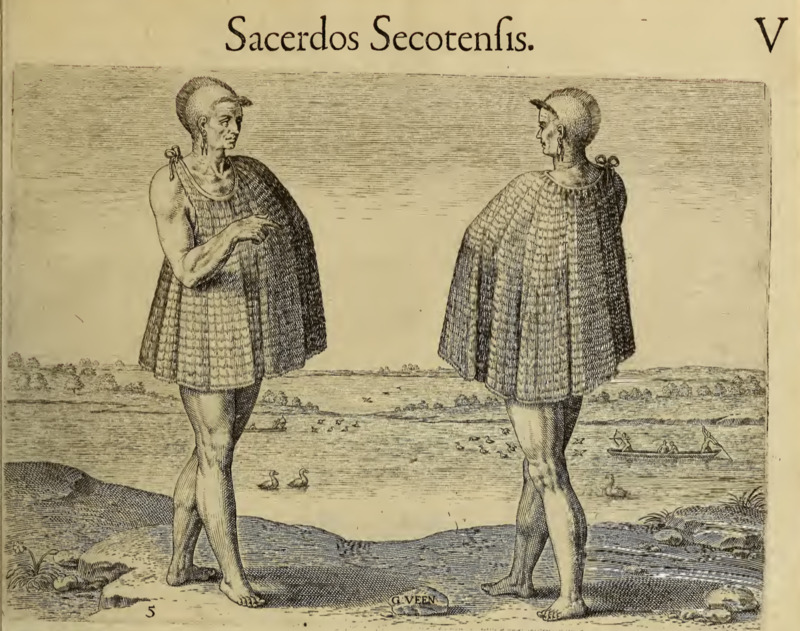
An Indigenous man (a shaman/priest/religious man) is shown standing on the bank of a river, from the front and from behind. He wears a cape-like garment, is barefoot, and wears no other adornment. In the river behind him, other Indigenous people are shown in canoes.
The left panel depicts Calisto dressed in regal attire. He has a falcon perched on his left arm, a obvious representation of his interest in falconry. He is also wearing a large chain, which is presumably the gold chain he gives to Celestina as payment for her services. In the right panel we see Melibea’s servant Lucrecia, who is wearing a veil and a robe. She is also holding flowers in her right hand. Even as a servant her robe appears somewhat ornate, perhaps intended to demonstrate the wealth of Melibea’s family. The entire image is nearly identical to the one found on page 216 (where the left panel is labeled ‘Pleberio’ and the right panel is labeled ‘Alisa’). The left panel is identical to the one found on page 88, and is nearly identical to those found on pages 135 (where it has a decorative panel and is labeled ‘Sepronio’ [likely a printing/engraving error]) and 244 (where it has a decorative panel and is labeled ‘Pleberio’). The right panel is nearly identical to the one found on page 61 (where it is labeled ‘Lucrecia’).
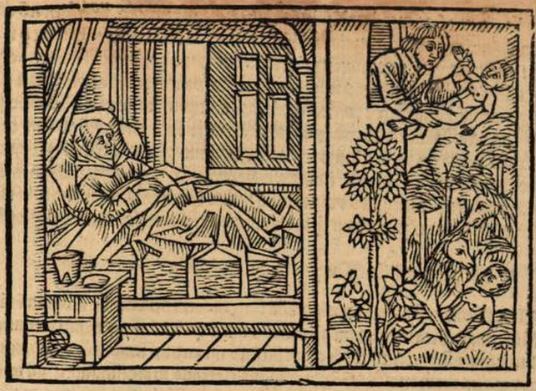
The vestal virgin Rhea Ilia is depicted on the left side of the engraving lying in a bed. She has a saddened expression on her face as she had just given birth to twin boys named Remus and Romulus who were forced to be exposed. Boccaccio explains that as a vestal virgin, she was forbidden from becoming pregnant. Her son’s Remus and Romulus are depicted on the right side of the engraving being exposed through the window. There are wolves surrounding Romulus on the ground as the mother wolf ends up raising the boys as her own. Rhea is buried alive for her punishment.
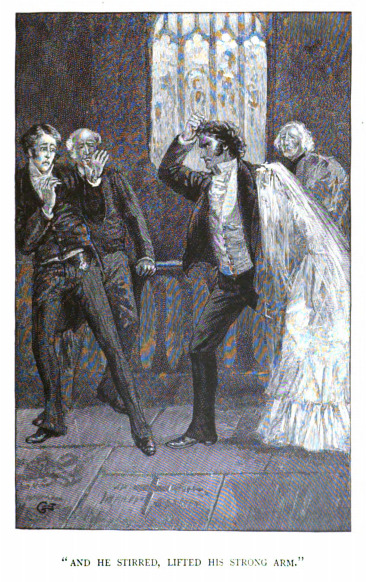
Here Mr. Rochester holds Jane’s veil before their wedding. This scene occurs when the truth about Mr. Rochester’s marriage came out. Mr. Rochester was married to a woman who suffered from severe mental illness, and so he confined her to the top floor of Thornfield. When Jane arrived, she was not told about Mr. Rochester’s wife, but she started walking through the halls at night, coming into Jane’s room the night before her wedding. Mr. Rochester’s brother-in-law confronted him about his marriage, seen here.
A woman in a coat and hat stands near the edge of a cliff, holding a pair of binoculars. In the upper right corner of the image is the letter W from “We”.
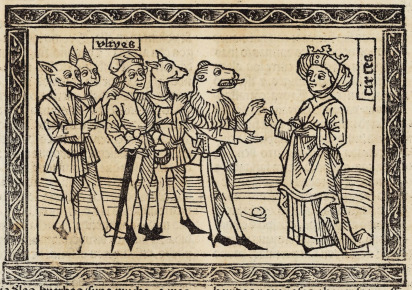
This engraving depicts Circe, the daughter of the Sun, on the right side of the engraving. We know that this is Circe as her name is engraved horizontally adjacent to her body. Boccaccio explains that Circe was skilled in the art of magic and would often turn people who landed on her shores into animals. When Ulysses and his men happened upon Circe, she transformed Ulysses’ companions into beasts. They are depicted in the engraving with their bodies still in human form, while their heads are changed into animals such as lions and pigs. Ulysses is the one man among them that is still in human form (his name is engraved above his head). Ulysses threatens Circe with his sword, and she eventually changes his companions back into their original forms.
This image is illustrated in a chapter that discusses the Christian priests in the colonial government in Peru. A Spanish priest is illustrated standing on the right side of the image as he approaches an indigenous prosecutor on the left. The priest is dressed in ecclesiastic adornments and the indigenous prosecutor is dressed in a vertically embroidered unku [nightgown]. The priest approaches the indigenous prosecutor as he wishes to confiscate all writing instruments in his new parish as he feared accusations being written against him. The prosecutor is illustrated handing a scribe’s writing instruments over to the priest.
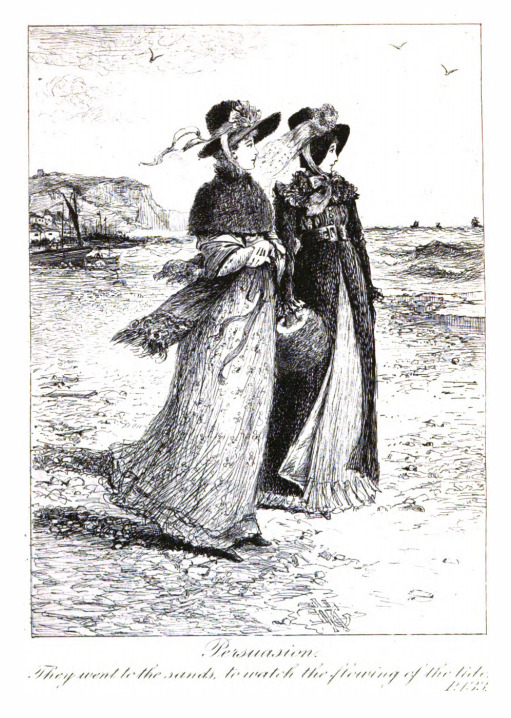
Here we see Anne and Henrietta walking on the beach. The party went to the seashore before breakfast. While walking a handsome man was looking at Anne, clearly finding her attractive. After their walk, they go back to the Inn and find the gentleman is also staying there. They learn that he is Mr. Elliot, a wealthy man who was their cousin and their father’s heir. Anne wished that they had been formally introduced, but her father and Mr. Eliot were not on good terms. This scene occurs in chapter 12 on page 133 as noted underneath the title of this image. The characters are shown in the traditional regency style, with Anne and Henrietta wearing the regency style dress with an empire waist. Their hair is worn tied up, as was tradition for women after their “coming out” before the queen, signaling her entrance into society, and they wear bonnets. The bonnet had a large brim, used to protect a woman’s face from the sun. These bonnets were a popular style in this era as going for walks were common pastimes. They wear fur shawls around their shoulders and have muffs and gloves to keep their hands warm. The regency period dated to the early nineteenth century (1811-1820) when George, Prince of Wales, later George IV (r. 1820-1830), reigned as regent for his mentally ill father, King George III (r. 1760-1820). The regency period is associated with the rise of neoclassicism in art and fashion.
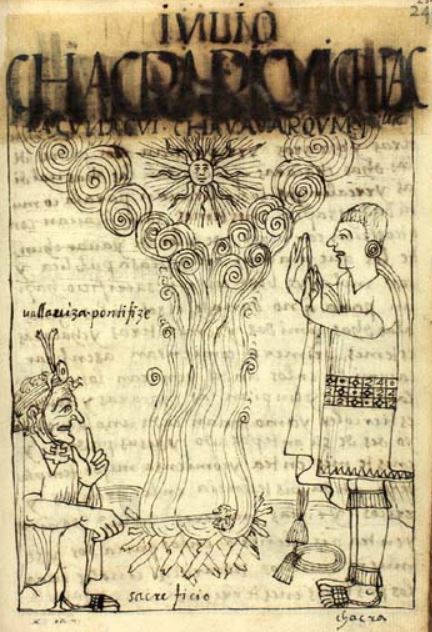
This chapter is dedicated to discussing the traditions and rituals of each month during the Inca Empire. The Incas tracked the months and years through the stars and their months consisted of thirty days. This image depicts the month of July. During the month of July, agricultural lands were inspected in order to be distributed amongst the Inca Empire. The author explains that llamas and guinea pigs were burned in a public square as a sacrifice to the sun and rains so that their crops would not get damaged. This was the month that farmers would sow their crops. This image depicts the sacrifice of llamas and guinea pigs. There is one man sitting on the left side of the image and another man standing on the right side of the image. They appear to be keeping the fire lit for their sacrifices. The sun is depicted shining through the smoke of the fire. The caption on the image reads “ualla uiza pontifize sacreficio,” which translates to “priest sorcerer pontiff, sacrifice.”
Calisto, unsure if his short encounter with Melibea the night before was a dream or a reality (to the right of the image he is seen reflecting on the night they shared), decides to interrogate Sempronio and Pármeno. He tells Tristan, one of his servants, to bring them to his bedchamber. Sosia, another of Calisto’s servants, arrives to Calisto's house in tears. He informs Tristan that Sempronio and Pármeno are dead (his arrival is depicted to the left of the image). Sosia and Tristan go to Calisto's bedchamber and inform him that his servants murdered Celestina the night before, after a dispute over the possession of a gold chain that Calisto had given her as payment for her services. To escape the city's night patrol (the alguacil's men), they leapt from a third-storey window in Celestina's house and suffered severe injuries, after which they were decapitated in the street by the patrol. Calisto blames this outcome on the unfortunate series of events that had unfolded recently, but also blames the dishonest and deceptive ways of Celestina. He entrusts Sosia and Tristan with the roles formerly held by Sempronio and Pármeno.
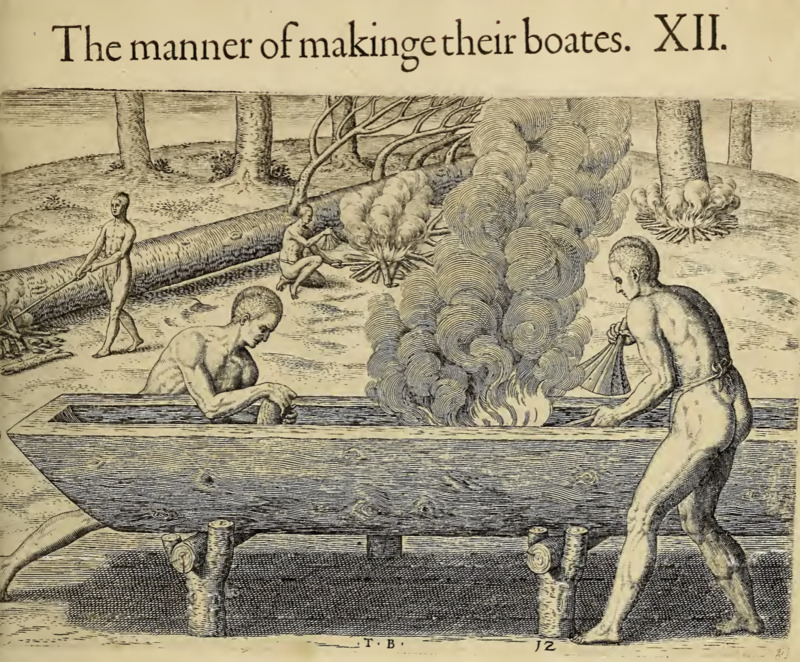
Indigenous men are shown in the process of making a canoe. The canoe they are working on is propped up on log braces. One of the men fans a fire inside the middle of the canoe while the other man scrapes the inside of one end of the canoe. In the background two other men are pictured tending to fires beside a large fallen tree, one at the base and one amongst the branches further up the trunk. There is also a fire at the base of another large tree in the background.
![[Gulliver is seen through a folding razor on Brobdingnag]](https://collections.cemvc.ca/files/large/0b5c823dea1ff78afa476769f14a8ac759c91d98.jpg)

![[animals acting as lawyers]](https://collections.cemvc.ca/files/large/81b3c5e848ebf1e2c2010e14c8db8cb372fdfc86.jpg)
![[Act XII – Calisto and Lucresse (Lucrecia)]](https://collections.cemvc.ca/files/large/f0b660b6d2089f5e7ae99084943b87ac10f8af57.jpg)
![[Vanity Fair Chapter LXIV Inhabited Initial]](https://collections.cemvc.ca/files/large/e3f58455bccab7b4daf8e7aa4febb7223c8b3e8c.jpg)
![Pide Escrivanias El P[adr]e al Fiscal y Dize el Fiscal, Esta [a]qui Senor, Darete de Escrivuanias y Tinteros una Carga. Dize el Padre, No Busco Eso Hijo que Manana me Yre Luego Daqui](https://collections.cemvc.ca/files/large/7fcf539b7fa2495b9f4059036d4caf6aa7ebdb6c.jpg)

![[Act XIII - The Misfortune of Sempronio and Pármeno]](https://collections.cemvc.ca/files/large/533c9d9903beead9e1b7ffd507499cce21a0b586.jpg)