This illustration depicts Veturia, a roman noblewoman, standing in front of her son, Coriolanus. There are two women standing behind Veturia as she speaks to her son. One woman is Coriolanus’ wife and the other is his daughter. Coriolanus had been exiled from Rome, and to exact his revenge on the city, he planned an attack in partnership with the Volscians. Veturia is depicted in this illustration convincing Coriolanus to not go forth with the attack and to not betray his city of birth and his family. She successfully convinces him to stop the attack. Boccaccio explains that he wrote on Vetruria to highlight the importance of filial respect and devotion.
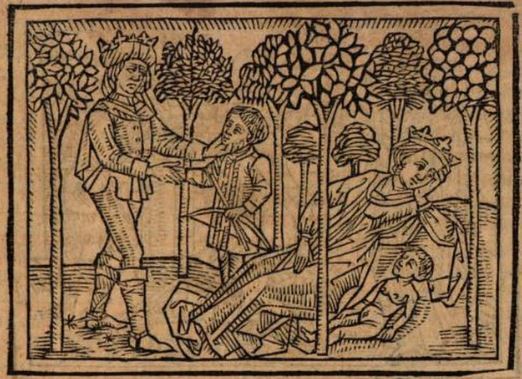
This engraving depicts Lavinia, the wife of Aeneas and queen of Laurentum, hiding in the forest with her baby in fear of her stepson, Ascanius. Boccaccio explains that after Aeneas died, Lavinia fled to the forest as she was afraid that her stepson would kill her and her newborn son, Silvius. Lavinia was wrong, and Ascanius voluntarily gave the kingdom of Laurentum back to her and helped raise Silvius. Ascanius is pictured on the left side of the engraving with his hand touching a young Silvius’ face with brotherly affection.
Intrigued by the European’s technology, Gulliver explained how he arrived on the island. He explained how ships work and used his handkerchief to explain the ship’s sails, seen here. In this image Gulliver uses his breath to simulate wind, using a handkerchief to simulate the sails to his master. Gulliver did this to explain how ships were built and how they worked and how he arrived in the Country of the Houyhnhnms. The same image appears in both the 1839 and 1843 Krabbe editions.
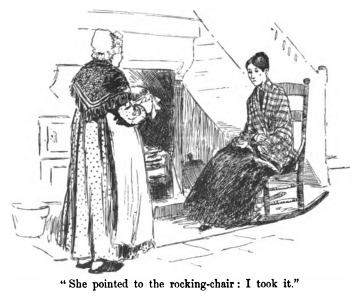
Here we see Jane after she arrived at the parsonage in Morton. The housekeeper, Hannah took her in and gave her a seat by the fireplace to warm up. Mr. Rivers, the parson for the village decided to allow Jane to stay with them until she regained her strength. Mr. Rivers then gave her a job working as the teacher for the school attached to the school.
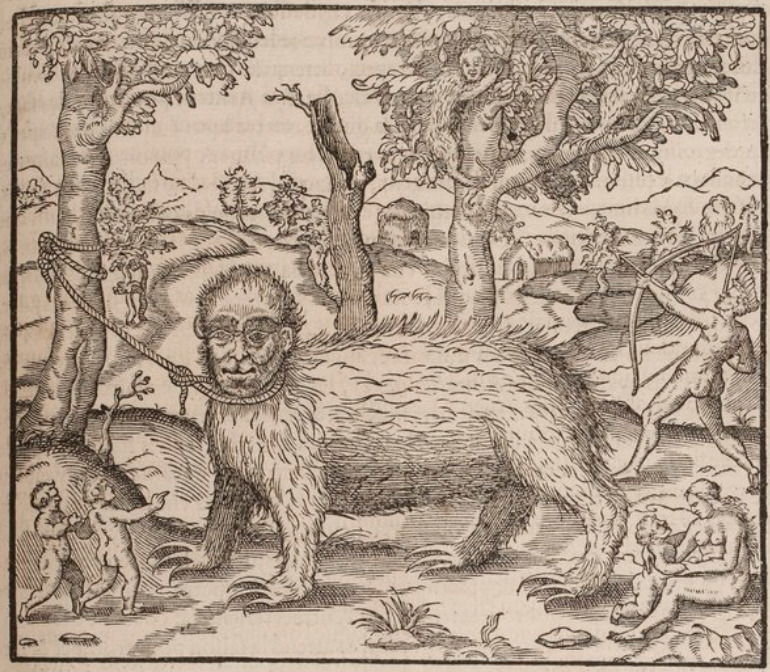
A large animal (the fictional representation of a sloth) stands on the ground, tied to a nearby tree by a rope around its neck. The animal has a bear-like body and a humanoid face, with three toes tipped with large claws on each foot. Two more of the creatures cling to a tree in the background and an Indigenous man aims a bow and arrow towards them. Two Indigenous children stand in front of the tethered sloth and a mother and child sit on the ground near the animal. According to the text, the name of the creatures, Haüt, or Haüthi, comes from the Indigenous name for the trees the sloths were commonly found in. Thevet calls them “beasts that live on air” because no one had managed to observe them eating. This image is identical to one found on page 941 of Paris, 1575 (l’Huillier).
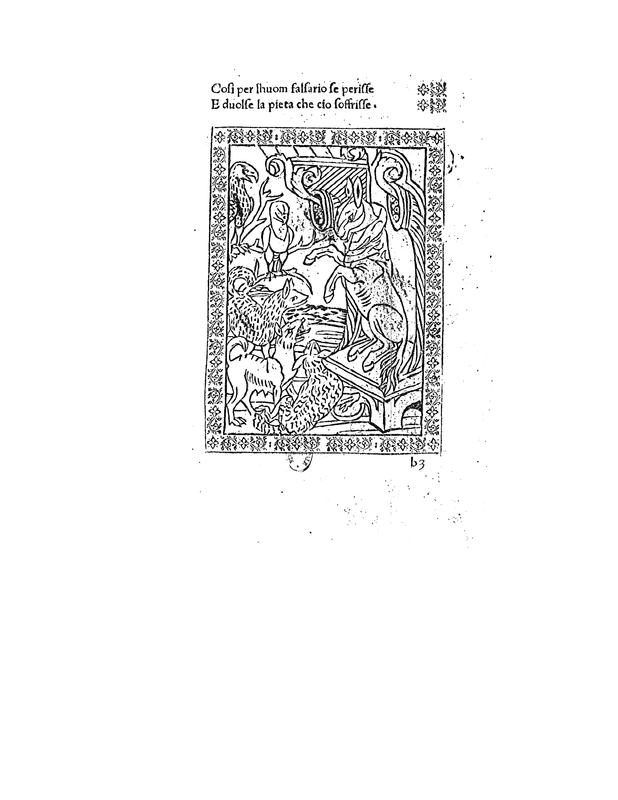
On the right side of the image there is a donkey elevated on a chair dressed in humans clothing who seems to be decieving the other animals. Surrounding the donkey are other animals on the ground including what seems to be a lamb, dog, and fox as well as two birds on the tree above. All the animals seem to be paying close attention to the doneky perhaps fooled into thinking he has authority.
Here we see Gulliver’s master holding Gulliver’s hand between his hoofs. Gulliver explains the difference between his body and his hands to those of females of his species. He explains that although he has nails on his hands and feet, the skin on his hands and feet were too soft to walk on without protection. The same image appears in the 1839 Krabbe edition.
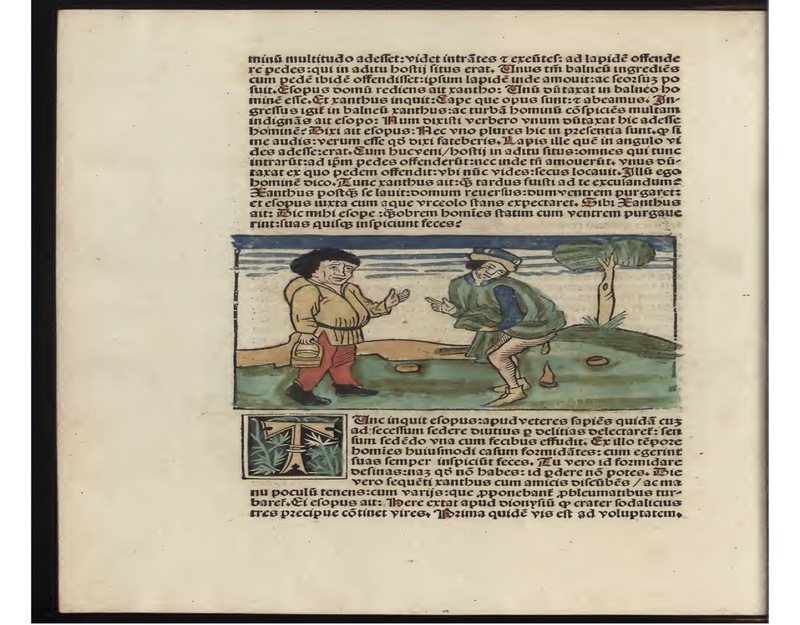
Two men stand outside on a hill. One man carries a basket and is talking to the man beside him. The other man has his gown drawn up and is in the act of defecating, which he turns his head to look at.
"In the middle of the image a lark is flying with a snail in its talons. Below them and on the right side of the image is a crow looking up at the pair. Below the snail and lark are some rocks."
Here we see two men fist fighting in the street, while a crowd watches from behind a short wall. Their hats and coats are on the ground. In the background we see a large castle, and a rooster. In this chapter Gulliver talks with the King of Brobdingnag about English traditions. Gulliver tells the King about diplomacy, religion, the justice system, the arts, the financial system, and the nobility, then debated these issues with the king. This image comes when Gulliver is discussing the judicial system. The same image appears in the 1843 Krabbe edition.
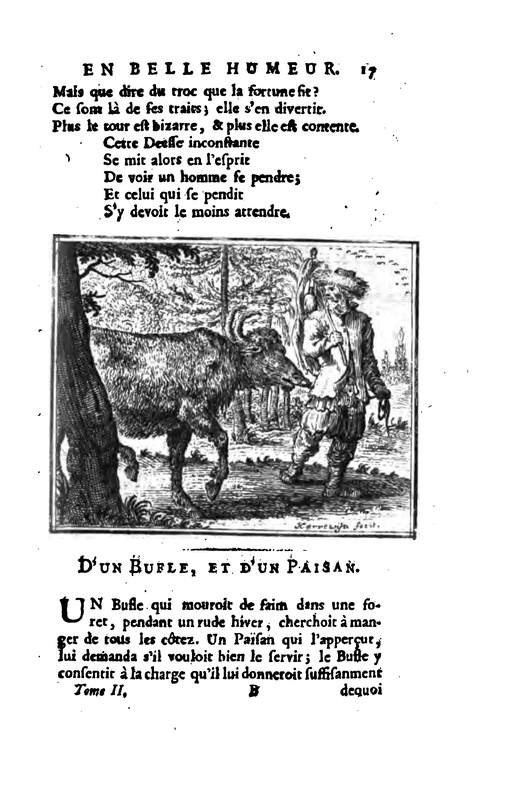
A man is leading a buffalo by the nostrils with a rope. The man has something behind his shoulders on a stick. There are trees and grass in the background. The illustration has the signature of Harrewijn in the bottom right corner.
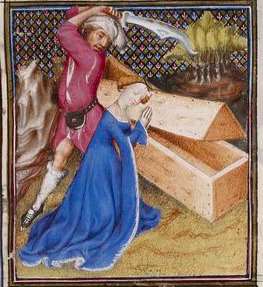
Polyxena, the lover of Achilles, offers her throat on Achilles’ tomb. Neoptolemus, Achilles’ son, holds the sword that will kill her. He wears the red cloak to the left of the image. She offers her life because in part, it seemed as though Polyxena was partially responsible for his death, as her mother Hecuba had her lead Achilles to the location of his death.
After Calisto and his servants flee from the alguacil’s men, they return to his house and Calisto goes to bed. Meanwhile, Sempronio and Pármeno decide to pay Celestina a visit, in order to claim their share of the gold chain that Calisto had awarded her. She refuses to give them what she had promised, making up excuse after excuse to get herself out of her obligation. They draw their swords and begin to threaten her, terrifying Elicia (as depicted here). Eventually, they snap and violently murder Celestina. Celestina and Elicia both cry for help, and Calisto's two servants hear the alguacil’s men coming toward the house. Seeing no other way to escape, Sempronio and Pármeno jump from the third storey window. Here Sempronio and Pármeno are seen with their swords drawn. Sempronio is wearing a hat, while Pármeno’s hat has fallen to the floor (in the bottom right corner of the image). Celestina, who is wearing a robe and a veil, has fallen to the ground in terror. Elicia, wearing a robe and a headband of some sort, appears to be urging them to lower their swords.
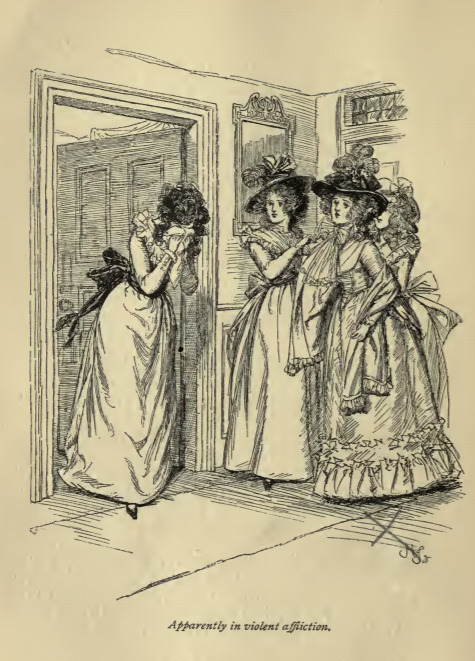
In this image Marianne runs out of the drawing room crying as Elinor, Mrs. Dashwood, and Margaret return home from a walk. In this scene, Willoughby had come to tell Marianne that he had to leave and would likely not be back at Barton Park for another year. Marianne was distraught to hear this, and spent several days crying in her room. This scene occurs in chapter 15. The characters are shown in the traditional regency style, as Marianne, Elinor, Margaret and Mrs. Dashwood wear the regency style dress with an empire waist. Elinor, Mrs. Dashwood, and Margaret wear bonnets, and Marianne hides her face in her handkerchief. The regency period dated to the early nineteenth century (1811-1820) when George, Prince of Wales, later George IV (r. 1820-1830), reigned as regent for his mentally ill father, King George III (r. 1760-1820). The regency period is associated with the rise of neoclassicism in art and fashion.
The Cid stands in front of an escaped lion, which has just broken into a room in which he was sleeping. His nephew Don Bermudo and his two sons-in-law were also in there. Bermudo was willing to fight the lion, while the sons-in-law hid, but rather than attack the lion kneeled at the feet of the Cid, apparently miraculously. Though the Cid forgave his sons-in-law for their cowardice, they resented him for it.
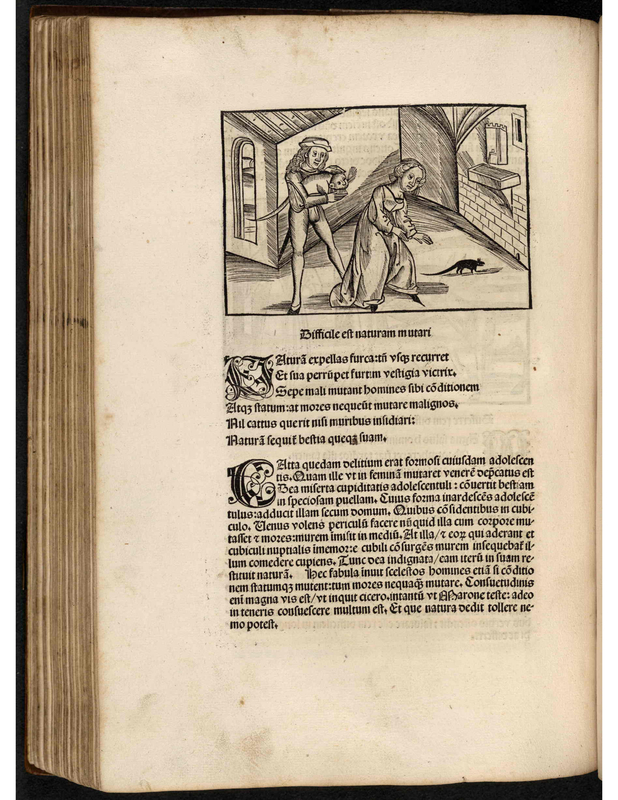
A man and a woman are standing outside of a building. The man is holding a medium sized animal. The woman is reaching towards a rat that is on the ground. The rat is moving toward a hole in the building.
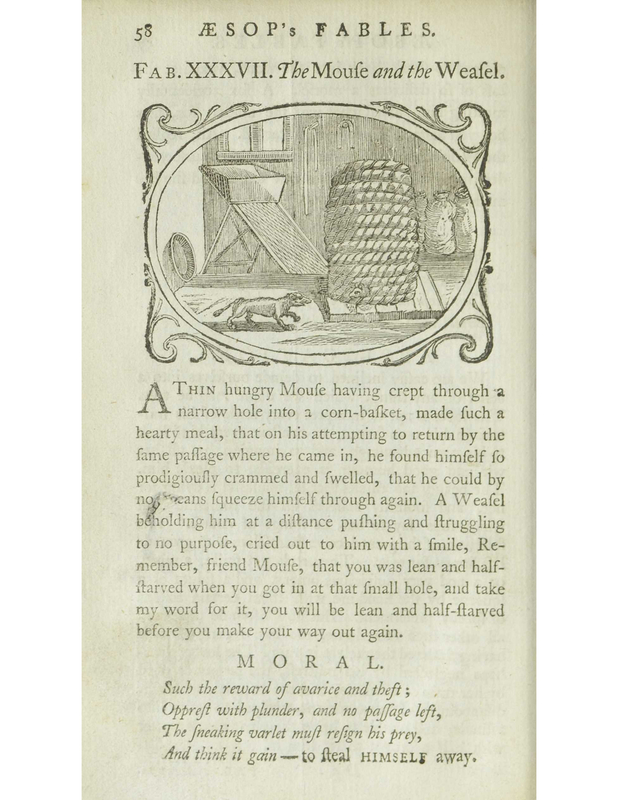
A weasel walks towards a large woven basket that is on the right side of the image. In the background some ropes hang on the wall and bags sit on the ground. There is a small rail by a window.
At the political school at the Grand Academy on Balnibarbi a medical doctor was attempting to use his knowledge of disease to heal the political system. He monitored the politicians and after several sessions, he prescribed them medicine which would help them to alter their behaviour at the next meeting in order to make the government run more smoothly. The connection between the human body and the political body was an analogy was created during the Renaissance and lasted until the eighteenth century when Swift was writing. Swift satirizes this idea in this concept of a medical doctor working to reform the political system. The same image appears in the 1843 Krabbe edition.
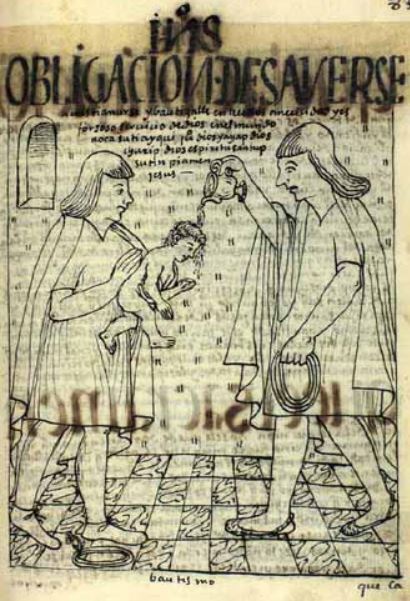
This image depicts a baptism of a young child performed by two indigenous men. The person on the left side of the image is illustrated holding a naked child forward while the man on the right pours water over the child’s head to baptize him. The author explains that baptism is a required sacrament, and even if there is no priest or Spaniard in a town, a commoner should perform the baptism to ensure the child does not go to purgatory or hell. The caption written above the two men, partially written in Quechua and partially in Spanish, reads, “Noca sutiayqui, Juan. Dios yayap, Dios churip, Dios Espíritu Santup sutinpi. Amén. Jesús” [I baptize you, Juan, in the name of the Father, and of the Son, and of the Holy Spirit, Amen, Jesus].

![[Veturia Convincing her Son Coriolanus Not to Attack Rome]](https://collections.cemvc.ca/files/large/75e5b2135896be77d3067d9444e021f88e343ddb.jpg)
![[Gulliver explains sailing using his handkerchief]](https://collections.cemvc.ca/files/large/877f2752c25ae32cbfde4213943c7135c3927678.jpg)

![[Gulliver’s master examines his hand]](https://collections.cemvc.ca/files/large/99289fdd3cac37a6fc25252b928fc7b3d1df93a2.jpg)
![[The Lark, the Snail, and the Crow]](https://collections.cemvc.ca/files/large/20004d46bfb24862b7fb440e48646018c0c71e3d.jpg)
![[Two men fist fight while a crowd watches]](https://collections.cemvc.ca/files/large/2b7f7db7c48cbb7006307106638f774f905aaf8f.jpg)
![[Act XII – Sempronio and Pármeno Slay Celestina, While Elicia Looks on in Horror]](https://collections.cemvc.ca/files/large/28c69641ea79a7067f48b4e2e7cebb49544449d1.jpg)