This illustration depicts what seems to be a wedding, as there is a priest standing in the centre of the image in front of the altar, with women on one side and men on the other. The woman directly beside the priest is Megullia Dotata. She is known for being a noblewoman with an enormous dowry. Her husband is illustrated receiving a bag full of money which is her dowry. Boccaccio explains that her dowry was said to have been 500,000 bronze coins.
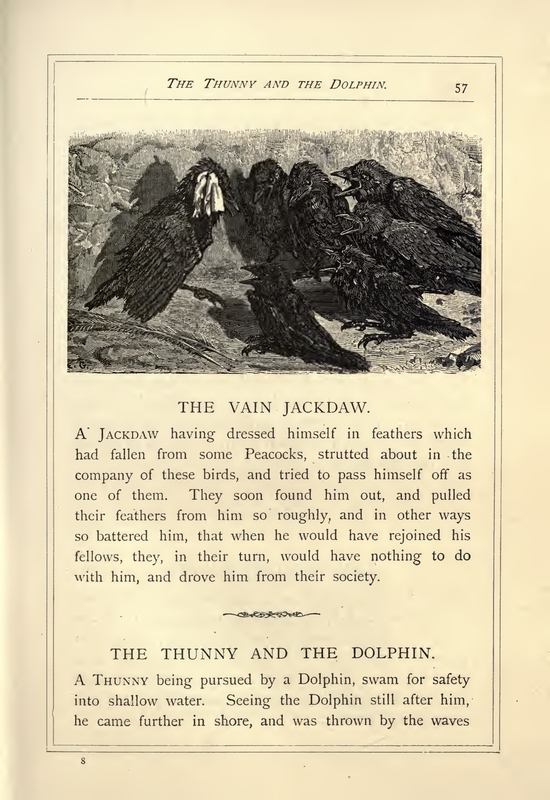
A jackdaw stand on the left-hand side of the image. It has a piece of white cloth stuck to its head, and a lone peacock feather lies next to him on the ground. In front of the jackdaw, a group of six other jackdaws with their beaks wide open are judging the other jackdaw.
While Pármeno accompanies Celestina (central figure) home, Celestina persuades him to help her scam Calisto. In exchange for his loyalty, he asks for Celestina’s prostitute Areusa, whom he loves. Celestina agrees, and they go to Areusa’s house. Celestina tells Pármeno to wait at the bottom of the stairs while she goes to Areusa’s bedroom (we see him waiting in the doorway to the left). Celestina tries to convince Areusa to give Pármeno a chance (foreground), but she eventually calls him to Areusa’s room without agreement from Areusa. Celestina returns home while Pármeno spends the night with Areusa.
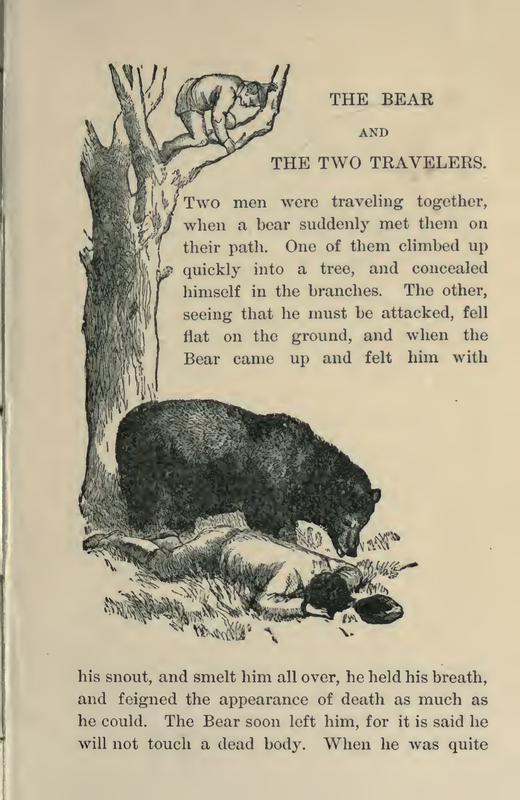
A bear is sniffing a man who lies face-first on the ground near a tree. Perched up in one of the branches of that tree is another man, looking down at his fellow traveler and the bear. The bear seems oblivious that there is another person in the tree.
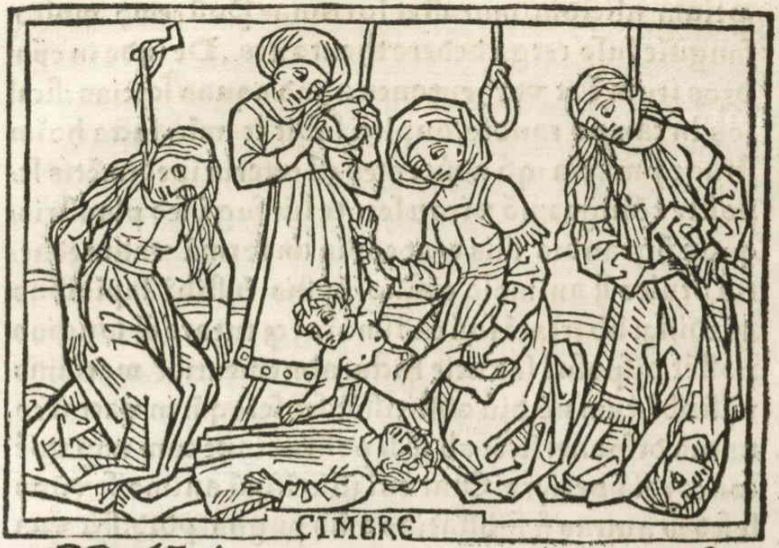
This engraving depicts the wives of the Cimbrians (a northern tribes-people) killing their children and hanging themselves. After their husbands were defeated in war against the Romans, the wives pleaded to their enemies for mercy and to let them become vestal virgins. When the Romans denied their request, they decided to kill their own children and hang themselves to save their virtue and to not die at the hands of their enemies. The word “Cimbre” is engraved at the bottom of the image which translates to the word “Cimbri” (the name of their tribe). Some women in the image are depicted with the nooses around their necks, and one woman is depicted killing her child before killing herself.
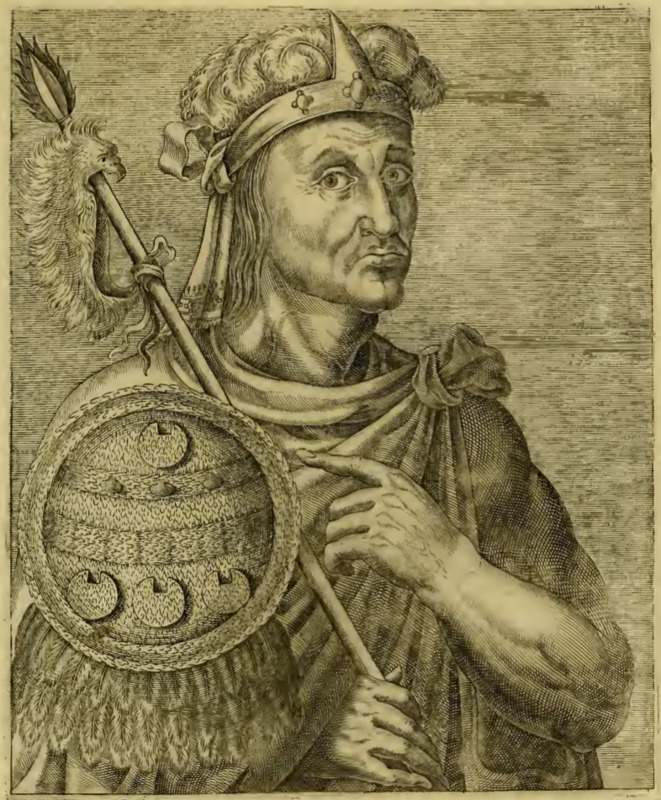
Motzume (Motecuhzoma in Nahuatl, Montezuma in Spanish) is shown in portrait from the waist up. His body is angled to his left and he gazes at the viewer. He wears a headdress that wraps around his head with a spike above his forehead, feathers around the top and a piece of cloth tied to the right side. Motecuhzoma wears a tunic bunched at his left shoulder and draping over his right side. He holds a spear in his right hand and point with his left at a small round shield with feathers around the lower rim. Motecuhzoma was the last Mexica (Aztec) ruler before the Spanish colonization, ruling from 1502 to 1520. After inviting a group of Spaniards led by Hernán Cortés into the city Tenochtitlan in late 1519, Motecuhzoma was taken hostage by the Spanish. This led to conflict between the Mexica and the Spanish, and Motecuhzoma was stoned to death in 1520 by his own people for his lack of action against the Spanish.
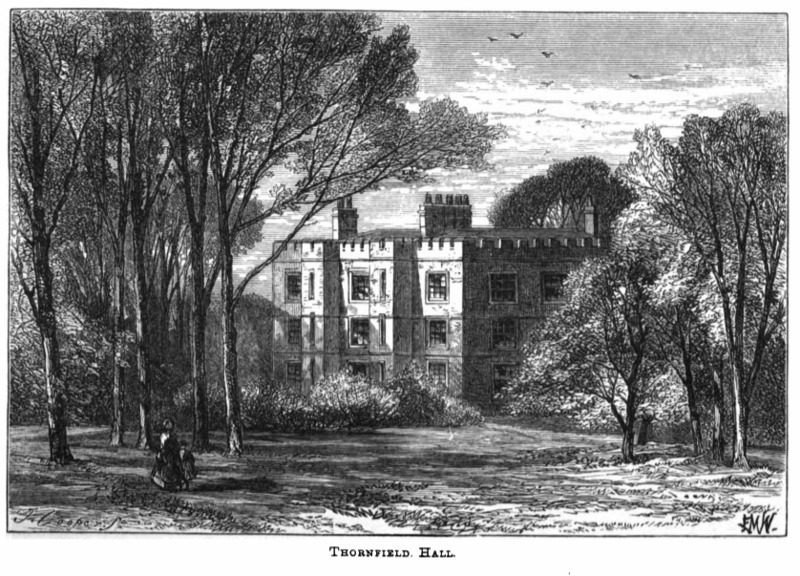
Here we see Thornfield Hall, where Jane Eyre lived under Mr. Rochester. She left Lowood School to become a governess to Adele Varens, Mr. Rochester’s charge. Adele’s mother was Mr. Rochester’s deceased French mistress. Jane worked for Mr. Rochester for a year before leaving after her engagement to Mr. Rochester was broken off after finding out he was already married.
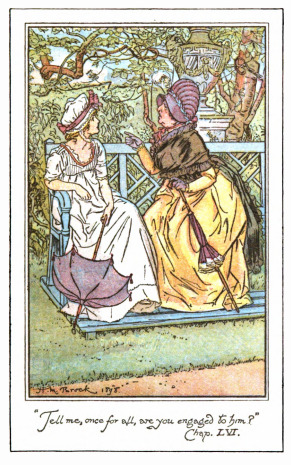
Here we see Elizabeth and Lady Catherine de Bourgh sitting outside on a bench in the Longbourn estate. Lady Catherine was Mr. Collins’ patron. She also hoped that her daughter would be the one to marry Mr. Darcy. She disapproved of Elizabeth’s rejection of Mr. Collins and her marriage to Mr. Darcy. Lady Catherine came to Longbourn to express her disapproval when rumours began to circulate regarding Elizabeth’s engagement to Mr. Darcy. She tried to force Elizabeth to never accept Mr. Darcy’s proposal, which Elizabeth refused. Upon this refusal, Lady Catherine left Longbourn quite angry. In this image Lady Catherine sits facing Elizabeth, pointing a finger at her in disapproval. This scene occurs in chapter 56 as noted underneath the title of this image. The characters are shown in the traditional regency style, with both Elizabeth and Lady Catherine the regency style dress with an empire waist. Their hair is worn tied up, as was tradition for women after their “coming out” before the queen, signaling her entrance into society. Both women wear a bonnet, a popular fashion of this period to protect her from the sun. Bonnets were especially popular because in this period a common pastime for women was going out on walks. Both hold parasols, umbrellas used to provide shade from the sun. The regency period dated to the early nineteenth century (1811-1820) when George, Prince of Wales, later George IV (r. 1820-1830), reigned as regent for his mentally ill father, King George III (r. 1760-1820). The regency period is associated with the rise of neoclassicism in art and fashion.
Gulliver explains the various medicines used in England to treat disease. In this image we see a doctor holding a large needle. The image represents a doctor giving a patient an enema. We also see a chamber pot on the floor next to the doctor. The same image appears in the 1843 Krabbe edition.
The garden’s wife stands outside her ivy-covered house, with the cityscape in the distant background. In front of her is young Rawdon Crawley, for whom she is the nurse, making mud pies in the dirt. Behind a low gate in the doorway of the house are two other young boys, either her own sons or other children over whom she is watching.
In this image we see Gulliver standing on a ladder, reading texts on Brobdingnag. The texts are written on scrolls, in a calligraphic style. Gulliver compares the writing style to that of Chinese script. Gulliver was given access to the royal library, and he read the texts while climbing on a ladder to see the text. Gulliver tells us that there are relatively few texts in the library. The same image appears in the 1839 Krabbe edition.
Here we see the shipwreck which resulted in Gulliver’s separation from the rest of the ship, then ending up in Lilliput. The image shows the large wave which overtook the ship, which we see as it tips over into the rough seas. The same image appears in the 1843 Krabbe edition.
This image is a depiction of scrolls, representing Swift’s education. This image is a part of Swift’s biography. The same image appears in the 1839 Krabbe edition.
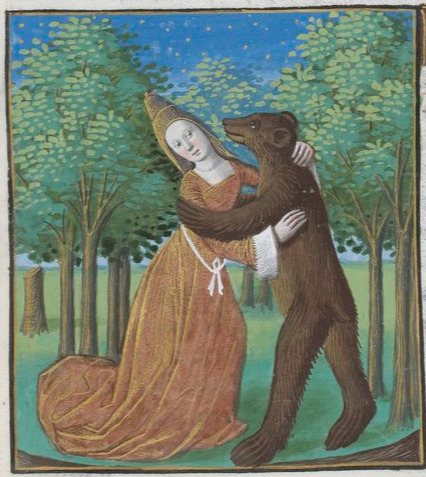
This illustration depicts Zenobia, the queen of Palmyra, wrestling with a bear. Boccaccio explains that Zenobia had cast aside womanly duties and practices and was incredibly strong and independent. She often spent her time in the woods where she would hunt animals such as bears and lions, which is why this illustration depicts her fighting a bear. Zenobia had such strength that when her husband went to war, she hid under her armour and fought alongside him.
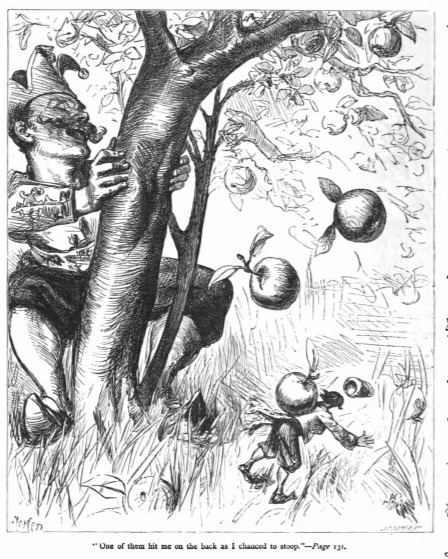
The Queen of Brobdingnag’s dwarf became jealous that Gulliver replaced him. In retaliation the dwarf found several ways to torment Gulliver. One way, shown here, was by shaking an apple tree, causing apples to fall on Gulliver. Because of the size of the apples, they could knock Gulliver flat on the ground when they hit him.
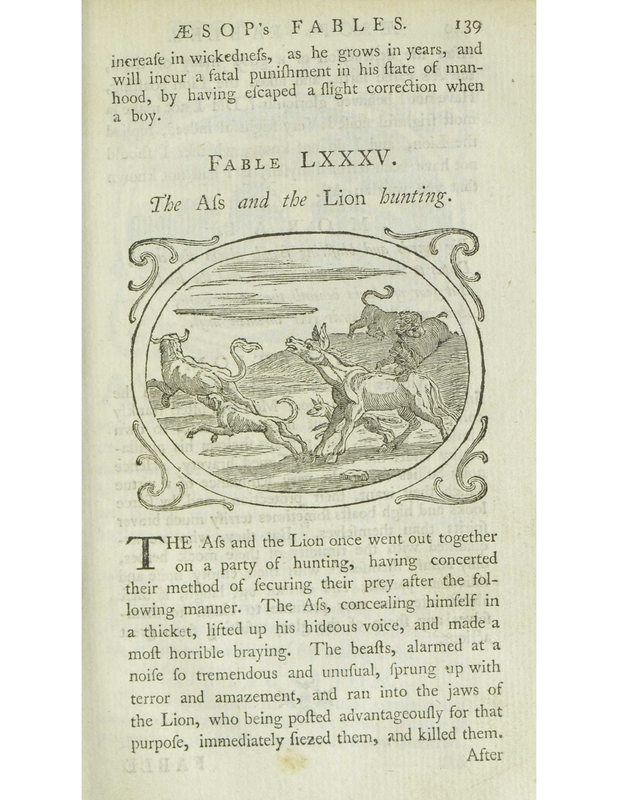
A donkey is seen making lots of noise causing all the animals around it to run in fear, while a lion can be seen taking down one of the many fleeing animals.
A drummer boy glances fearfully around the battlefield as he plays a beat upon his drum. The background is of low hills and clouds of smoke, with the letter T from “Thus” in the top right corner.
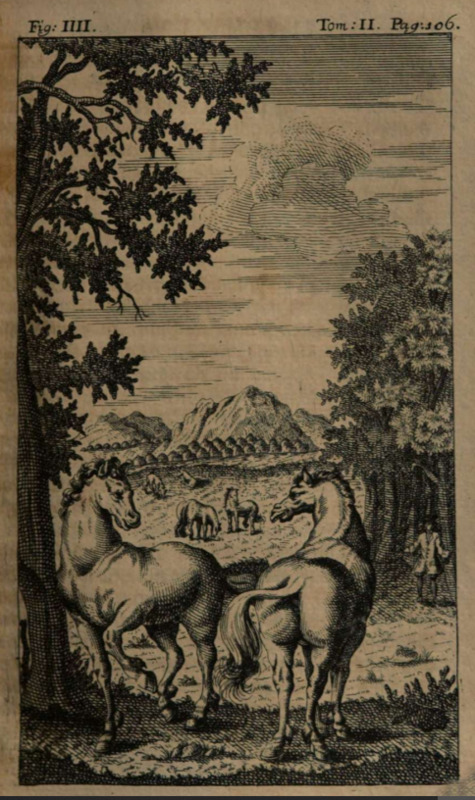
This image shows some of the Houyhnhnms (horses). In the foreground are two horses, with Gulliver in the background on the right hand side. There are several other horses in the background. The landscape is made up of trees and hills. This image also appears in the 1739 von Wiering edition.
This image is a depiction of Gulliver and the giant farmer who shelters Gulliver in Brobdingnag. The farmer carries a scythe to indicate his position. The image is a part of Swift’s biography which precedes Part One of Gulliver’s Travels. The purpose of this illustration in the biography is to provide context for the political atmosphere and insight into Swift’s satirical writings. The same image appears in the 1839 Krabbe edition.
In this image we see Gulliver learning to read the language of the giants from Brobdingnag. We see Glumdalclitch’s hands, one holding the book, the other holding a pointer. On the page we see different letters, Glumdalclitch pointing to different ones. Gulliver is seated, holding on to one page. The same image appears in the 1843 Krabbe edition.

![[Megullia Dotata Being Given Away with a Massive Dowry]](https://collections.cemvc.ca/files/large/0dfc5ab8ffb302160a023519327a6e3b8563b030.jpg)
![[Act VII – Celestina Talking with Areusa While Pármeno Waits by the Stairs]](https://collections.cemvc.ca/files/large/c3540115cc8c58d939e8d47dd7ba7a9821dbe3b7.jpg)

![[a doctor holds a needle]](https://collections.cemvc.ca/files/large/4955d0b075aff78852eddd73133c4577ea5acc9f.jpg)
![[Little Rawdon and his Nurse]](https://collections.cemvc.ca/files/large/04c18a2b211ed94738b8219c0a10101e5241b296.jpg)
![[Gulliver reads scrolls in the library on Brobdingnag]](https://collections.cemvc.ca/files/large/afe91fe26eea10ac27c7e7ae8071457279e76788.jpg)
![[Gulliver's shipwreck]](https://collections.cemvc.ca/files/large/66b7f032e5ba4c4018a8abed1b5ee015c24a9d6a.jpg)
![[Scrolls]](https://collections.cemvc.ca/files/large/c471c0bc906cc678a466db7ed59fa525acf5cb42.jpg)

![[Vanity Fair Vol. I Chapter XXXI Historiated Initial]](https://collections.cemvc.ca/files/large/b0144037b02d6ade4acbe7f92599a760d177b27a.jpg)
![[Gulliver and a giant from Brobdingnag]](https://collections.cemvc.ca/files/large/784adfeffbe849b4fbf27efb2eb072ce96c54792.jpg)
![[Glumdalclitch teaches Gulliver to read the language of the giants from Brobdingnag]](https://collections.cemvc.ca/files/large/49379b133512c77698d87820147271485a03c512.jpg)